Topic 8 · page 15 of 29
Flame colours and electron transitions
Heat lifts an electron in a metal ion to a higher energy level. When it falls back it gives out light with a frequency set by the energy gap, so each metal gives its own flame colour. Learn the colours and the flame-test method.
Where the colour comes from 8.17
The electrons in an atom or ion sit in energy levels. Each level has a fixed energy, and an electron can only exist in a level, not between them.
- In a hot flame, an electron absorbs energy and jumps up to a higher energy level. It is now excited.
- An excited electron is unstable. It falls back to a lower level.
- The energy lost is given out as light. The light has a single frequency for each fall, set by the energy gap: .
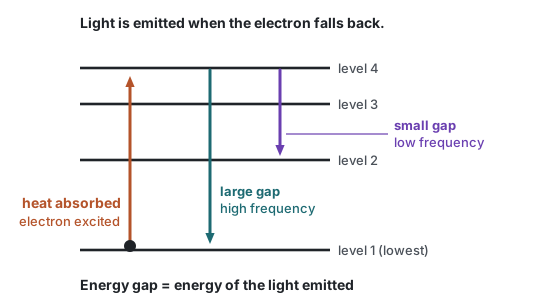
A bigger gap gives light of higher frequency, towards the violet end of the visible spectrum; a smaller gap gives lower frequency, towards the red end. Because each element has its own pattern of energy levels, the mixture of frequencies it emits is different, and the eye sees a different colour.
The colours 8.17
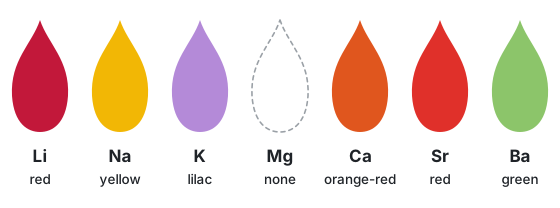
| Metal ion | Flame colour |
|---|---|
| Lithium, Li⁺ | red (crimson) |
| Sodium, Na⁺ | yellow |
| Potassium, K⁺ | lilac |
| Magnesium, Mg²⁺ | no colour |
| Calcium, Ca²⁺ | orange-red (brick red) |
| Strontium, Sr²⁺ | red (crimson) |
| Barium, Ba²⁺ | green (pale or apple green) |
The three reds are the hard part. Lithium and strontium are both red or crimson; calcium is more orange. In an exam, give the colour exactly as the mark scheme words it, and do not try to tell lithium and strontium apart by shade alone. Use a chemical test if you need to. Magnesium gives no visible colour in a Bunsen flame: the answer is "no colour", not "white".
Practical: flame tests 8.188.18(ii)
PracticalTesting a compound
- Clean a nichrome wire loop by dipping it in concentrated hydrochloric acid, then heating it in a blue Bunsen flame until it gives no colour. Repeat until clean.
- Dip the loop in the acid again (this wets it), then into a small amount of the solid to be tested, so that some sticks to it.
- Hold the loop in the edge of the blue flame. Record the colour.
- Clean the wire again before the next sample.
Why these steps are done:
- Concentrated HCl cleans the wire: it converts metal impurities into volatile chlorides that boil off in the flame. A wire that still gives a yellow flame is contaminated by sodium, which is nearly everywhere and hides other colours.
- A blue flame has little colour of its own, so the sample colour is easy to see.
- The chloride of the metal is the best compound to test because it is volatile enough to reach the flame.
Check yourself
- State the flame colour of lithium, sodium, potassium and calcium compounds.
- Explain how a flame colour is produced in terms of electrons.
- Why does each metal ion give a different colour?
- A white solid gives a lilac flame. Name the metal ion present and name one compound that could be the solid.
- Describe how to carry out a flame test, including how the wire is cleaned.
- A student's flame test on a potassium salt gives a strong yellow flame. Suggest why and how to correct it.
Answers cover these until you have tried the questions
- Lithium red; sodium yellow; potassium lilac; calcium orange-red (brick red).
- Heat in the flame gives electrons energy, so they are excited to a higher energy level. When they fall back to a lower level, the energy difference is released as light of a particular frequency, which is seen as a colour.
- The metal ions have different energy gaps between their levels. So the frequencies of light given out are different, and so is the colour seen.
- Potassium (K⁺). The solid could be potassium chloride, KCl (or potassium nitrate, KNO₃, or another potassium compound).
- Dip a nichrome wire in concentrated HCl and heat it in a blue flame until there is no colour. Dip it in the acid again, then in the solid. Hold it in the edge of the blue flame and record the colour. Clean it before the next sample.
- Sodium contamination: sodium is a very common impurity and its yellow flame hides the lilac. Clean the wire again with concentrated HCl until it burns with no colour, and retest.