Topic 8 · page 17 of 29
Ammonium ions and identifying an unknown salt
Sodium hydroxide and gentle warming release ammonia from ammonium ions, which turns damp red litmus blue and makes white smoke with hydrogen chloride. Combine the ion tests, flame tests and decomposition tests to identify an unknown.
Read first: Tests for carbonate, hydrogencarbonate and sulfate ions
Ammonium ions 8.198.19(iii)
An ammonium ion, NH₄⁺, is a weak acid. A strong base such as hydroxide removes H⁺ from it, leaving ammonia, NH₃, a gas.
The ammonia is then identified. It is the only common gas that is alkaline.
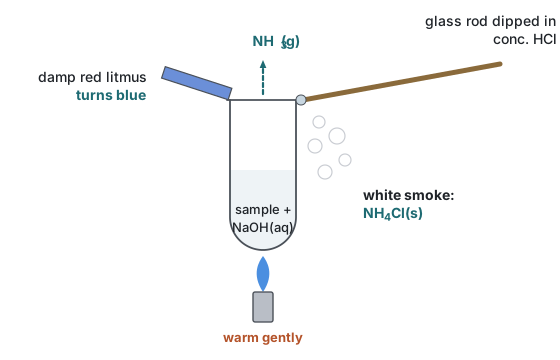
MethodTest for ammonium ions
- Add sodium hydroxide solution to the sample in a test tube.
- Warm the mixture gently.
- Hold damp red litmus paper at the mouth of the tube. It turns blue if ammonia is given off.
- As a second test, hold a glass rod dipped in concentrated hydrochloric acid near the mouth of the tube: white smoke forms.
The white smoke is tiny crystals of solid ammonium chloride, made when the two gases meet:
Identifying an unknown salt 8.198.19(iii)
A question may give a salt and ask you to find which ions it contains. Each test works on one ion, so use the tests in turn and write down what each one tells you.
| Ion | Test | Positive result |
|---|---|---|
| Li⁺, Na⁺, K⁺, Ca²⁺, Sr²⁺, Ba²⁺ | flame test (page 15) | red, yellow, lilac, orange-red, red, green |
| CO₃²⁻ or HCO₃⁻ | dilute acid, then limewater | fizzing; limewater turns milky |
| SO₄²⁻ | dilute HCl, then BaCl₂(aq) | white precipitate |
| NH₄⁺ | NaOH(aq), warm; damp red litmus | litmus turns blue; white smoke with HCl |
Worked exampleIdentifying a white solid
A white solid X is soluble in water. (a) A flame test gives a lilac flame. (b) Warmed with dilute hydrochloric acid, it fizzes and the gas turns limewater milky. (c) A solution of X gives no precipitate with BaCl₂(aq) after acidifying with HCl. Identify X.
- (a) Lilac flame: the cation is potassium, K⁺.
- (b) Fizzing with acid and a milky limewater: carbon dioxide, so the anion is carbonate or hydrogencarbonate.
- (c) No white precipitate with acidified barium chloride: no sulfate.
- Conclusion: X is potassium carbonate or potassium hydrogencarbonate, or .
Worked exampleTwo tests for ammonium sulfate
Describe two tests to show that a solid is ammonium sulfate.
- Ammonium: warm the solid with sodium hydroxide solution. Damp red litmus paper at the mouth of the tube turns blue, showing ammonia, so NH₄⁺ is present.
- Sulfate: dissolve a sample in water, add dilute hydrochloric acid, then barium chloride solution. A white precipitate of BaSO₄ shows SO₄²⁻.
Check yourself
- Describe how to test for ammonium ions, and write the ionic equation for the reaction with hydroxide ions.
- Explain why red litmus paper must be damp in the ammonia test.
- Describe what you would see when a glass rod dipped in concentrated hydrochloric acid is held near ammonia gas, and write the equation.
- A white solid gives a green flame. A solution of it gives a white precipitate when dilute sulfuric acid is added. Identify the metal ion, name the precipitate and write the ionic equation.
- A student acidifies a solution with dilute sulfuric acid before adding barium chloride and gets a white precipitate. Explain why this does not show sulfate in the original sample.
- Describe a test sequence to identify a white solid as sodium sulfate rather than sodium carbonate.
Answers cover these until you have tried the questions
- Add sodium hydroxide solution and warm. Hold damp red litmus paper at the mouth of the tube: it turns blue.
- Ammonia is a gas. It has to dissolve in the water on the paper to form hydroxide ions, which are the alkali that changes the litmus colour. Dry paper does not change colour.
- White smoke (a fine white solid).
- A green flame shows barium, Ba²⁺. The white precipitate is barium sulfate, which is insoluble (the sulfates become less soluble down Group 2).
- Sulfuric acid adds sulfate ions itself, so barium chloride would give a white precipitate of BaSO₄ whatever the sample contains. The test must be acidified with hydrochloric acid.
- Add dilute hydrochloric acid to a sample: sodium carbonate fizzes, sodium sulfate does not. Then add barium chloride: sodium sulfate gives a white precipitate of BaSO₄ (in the acidified solution); sodium carbonate gives none, because it has already reacted with the acid.