Topic 8 · page 23 of 29
Trends in Group 7
Down Group 7 the molecules have more electrons, so London forces and boiling temperatures rise (gas, liquid, solid). The atoms get bigger, so electronegativity and the ability to gain an electron fall: halogens become less reactive down the group.
Melting and boiling temperatures and state 8.248.24(i)
The halogens are diatomic molecules, X₂. Each one is held to its neighbours by London forces only.
| Cl₂ | Br₂ | I₂ | |
|---|---|---|---|
| Colour | pale green | red-brown | grey-black |
| State at room temperature | gas | liquid | solid |
| Melting temperature / °C | −101 | −7 | 114 |
| Boiling temperature / °C | −34 | 59 | 184 |
| Electrons per molecule | 34 | 70 | 106 |
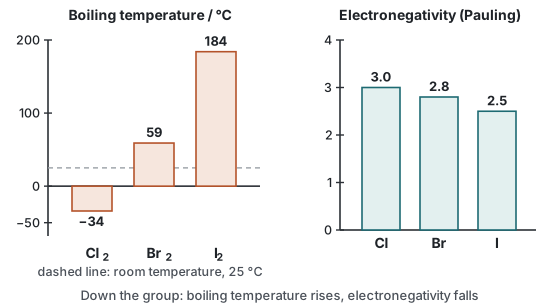
Down the group each molecule has more electrons, so the electron cloud is bigger and easier to distort. The instantaneous dipoles are larger, so the London forces between molecules are stronger. More energy is needed to separate the molecules, so the melting and boiling temperatures increase. At room temperature (about 25 °C), chlorine is above its boiling temperature (a gas), bromine is between its melting and boiling temperatures (a liquid) and iodine is below its melting temperature (a solid).
Electronegativity 8.248.24(ii)
| F | Cl | Br | I | |
|---|---|---|---|---|
| Electronegativity (Pauling) | 4.0 | 3.0 | 2.8 | 2.5 |
Electronegativity decreases down the group. Going down:
- The atoms have more shells, so the bonding pair is further from the nucleus.
- There are more inner shells to shield it from the nuclear charge.
- The nucleus attracts the bonding pair less strongly, even though its charge is larger.
Reactivity down the group 8.248.24(iii)
A halogen reacts by gaining an electron: . It is an oxidising agent. How readily it gains an electron decides how reactive it is.
- The incoming electron joins the outer shell, which is further from the nucleus down the group.
- It is more shielded, so the nucleus attracts it less strongly.
- So the atom gains the electron less easily, and is a weaker oxidising agent.
The evidence for the trend is in the next pages: chlorine displaces bromide and iodide from solution, bromine displaces iodide, and iodine displaces neither.
Check yourself
- State the physical state of chlorine, bromine and iodine at room temperature.
- Explain why the boiling temperature of iodine is higher than that of bromine.
- State the trend in electronegativity down Group 7 and explain it.
- A student says "the boiling temperature increases because the I–I bond is stronger than the Br–Br bond". Explain what is wrong.
- Explain why chlorine is a stronger oxidising agent than iodine.
- Compare the way reactivity changes down Group 1 with the way it changes down Group 7, and explain the difference.
Answers cover these until you have tried the questions
- Chlorine is a gas, bromine a liquid, iodine a solid.
- I₂ has more electrons (106) than Br₂ (70), so its London forces between molecules are stronger. More energy is needed to separate the molecules, so its boiling temperature is higher.
- Electronegativity decreases (3.0, 2.8, 2.5 from Cl to I). Down the group the atoms have more shells, so the bonding pair is further from the nucleus and more shielded, so it is attracted less strongly.
- Boiling does not break the covalent bond in the molecule. It overcomes the London forces between molecules. The temperature rises because there are more electrons and stronger London forces.
- The incoming electron goes into the outer shell. In chlorine this shell is closer to the nucleus and less shielded, so the attraction is stronger and chlorine gains an electron more easily.
- Group 1 reactivity increases down the group, because the metals react by losing their outer electron, which is easier when it is further out and more shielded. Group 7 reactivity decreases, because the halogens react by gaining an electron, which is harder when the electron goes in further out and more shielded.