Topic 20 · page 15 of 15
Core Practical 16: preparing aspirin
Warm 2-hydroxybenzoic acid with ethanoic anhydride and a little acid catalyst, crystallise the crude aspirin, recrystallise it, then check its purity by melting temperature and calculate the percentage yield.
Read first: Recrystallisation, melting and boiling temperatures, Choosing a procedure and controlling risk
Aim and reaction 20.4
To prepare a sample of aspirin (2-ethanoyloxybenzoic acid) from 2-hydroxybenzoic acid, to purify it by recrystallisation, to check its purity from its melting temperature, and to calculate the percentage yield.
The –OH group on the benzene ring of 2-hydroxybenzoic acid is a phenol group. It reacts with ethanoic anhydride to form an ester, with ethanoic acid as the other product.
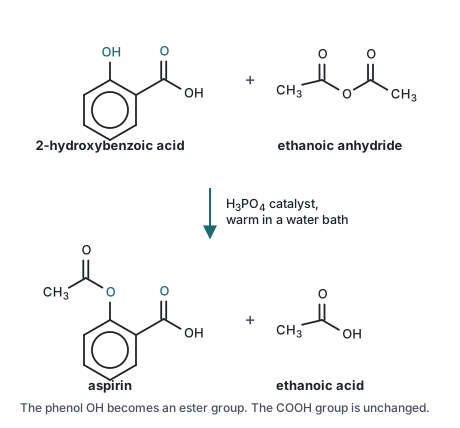
Method 20.4
PracticalPreparing crude aspirin
- Weigh about 2 g of 2-hydroxybenzoic acid into a dry pear-shaped flask. Record the mass.
- In a fume cupboard, add about 4 cm³ of ethanoic anhydride and a few drops of concentrated phosphoric acid.
- Warm in a hot water bath at about 80 °C for about 20 minutes, swirling from time to time.
- Add cold water carefully to destroy the excess ethanoic anhydride. Cool the flask in ice until crystals form, scratching the inside if necessary.
- Filter under reduced pressure, wash with a little ice-cold water, and press the crystals dry.
Quantities and the temperature are typical. If your teacher's method differs, follow it. The reasons for each step stay the same.
| Step | Reason |
|---|---|
| dry flask | ethanoic anhydride reacts with water |
| ethanoic anhydride in excess | the reaction goes to completion; the anhydride is cheap |
| fume cupboard | the vapour of ethanoic anhydride is harmful and irritating |
| water bath, not a flame | the anhydride is flammable |
| cold water added at the end | it reacts with the excess anhydride and makes the aspirin crystallise |
| cool in ice | aspirin is only slightly soluble in cold water, so more crystals form |
| wash with ice-cold water | removes the soluble impurities without dissolving much aspirin |
The excess ethanoic anhydride is turned into ethanoic acid, which dissolves in the water and is filtered off.
What you see
| Observation | Explanation |
|---|---|
| the solid dissolves on warming | it dissolves in, and reacts with, the hot anhydride |
| a smell like vinegar | ethanoic acid is formed as a by-product |
| white crystals form on cooling in ice | aspirin is only slightly soluble in cold water |
| the crude product melts low and over a range | it is impure |
Purifying and checking 20.420.5(iv)20.5(viii)
The crude aspirin contains traces of 2-hydroxybenzoic acid and other impurities. Recrystallise it, as on page 13.
PracticalRecrystallising aspirin
- Dissolve the crude aspirin in the minimum volume of hot solvent, such as hot water, or hot ethanol with water added.
- Cool slowly, then in an ice bath, so crystals form.
- Filter under reduced pressure and wash with a little ice-cold solvent.
- Dry the crystals between filter papers or in a desiccator.
- Measure the melting temperature with a capillary tube.
Pure aspirin melts sharply at about 136 °C. The crude product melts lower and over a wider range, so the recrystallised product, with a narrow range close to 136 °C, shows that the aspirin is purer.
Calculating the yield 20.4
Worked examplePercentage yield of aspirin
Illustrative data. 2.00 g of 2-hydroxybenzoic acid ( = 138.0) gives 1.80 g of pure aspirin ( = 180.0).
- n(2-hydroxybenzoic acid) = 2.00 ÷ 138.0 = 0.01449 mol.
- The equation is 1 : 1, so the theoretical n(aspirin) = 0.01449 mol.
- Theoretical mass = 0.01449 × 180.0 = 2.609 g.
- Percentage yield = 1.80 ÷ 2.609 × 100 = 69.0%.
Worked exampleChecking that the anhydride is in excess
Illustrative data. 4.0 cm³ of ethanoic anhydride (density 1.08 g cm⁻³, = 102.0) is used with 2.00 g of 2-hydroxybenzoic acid.
- Mass of anhydride = 4.0 × 1.08 = 4.32 g, so n = 4.32 ÷ 102.0 = 0.0424 mol.
- n(2-hydroxybenzoic acid) = 0.01449 mol, from the worked example above.
- The ratio is 0.0424 ÷ 0.01449 = 2.9, so the anhydride is in about threefold excess and the acid is the limiting reactant.
- The yield is therefore worked out from the 2-hydroxybenzoic acid, never from the anhydride.
Why the yield is below 100% 20.4
| Source of loss or error | Effect |
|---|---|
| some product stays dissolved in the cold water or the recrystallisation solvent | lowers the yield |
| product left on the glassware and filter paper | lowers the yield |
| the reaction does not go to completion | lowers the yield |
| some aspirin hydrolyses in hot water during recrystallisation | lowers the yield |
| crystals not dried properly | the mass is too high, so the yield appears too high |
Check yourself
- Explain why ethanoic anhydride is used instead of ethanoic acid, and state the role of phosphoric acid.
- Why is cold water added at the end of the reaction, and why must the water used to wash the crystals be ice-cold?
- 3.00 g of 2-hydroxybenzoic acid gives 2.70 g of aspirin. Calculate the percentage yield.
- Calculate the mass of 2-hydroxybenzoic acid needed to make 2.50 g of aspirin if the percentage yield is 69.0%.
- Crude aspirin melts at 128–133 °C. After recrystallisation it melts at 135–136 °C. Explain what this shows.
- A student reports a percentage yield of 104%. Suggest what has gone wrong and how to find out.
Answers cover these until you have tried the questions
- A phenol reacts slowly with a carboxylic acid and the reaction is reversible, so the yield is low. The anhydride is more reactive, so the reaction is faster and it goes to completion. Phosphoric acid is a catalyst: it speeds up the reaction and is not used up.
- Cold water reacts with the excess ethanoic anhydride, forming ethanoic acid that dissolves, and it makes the aspirin crystallise. Ice-cold water is used for washing because aspirin is only slightly soluble in cold water; warm water would dissolve some of the product and lower the yield.
- n(2-hydroxybenzoic acid) = 3.00 ÷ 138.0 = 0.02174 mol. Theoretical mass of aspirin = 0.02174 × 180.0 = 3.913 g. Percentage yield = 2.70 ÷ 3.913 × 100 = 69.0%.
- n(aspirin) needed = 2.50 ÷ 180.0 = 0.013889 mol. At 69.0% yield the amount of acid needed is 0.013889 ÷ 0.690 = 0.02013 mol. Mass = 0.02013 × 138.0 = 2.78 g.
- The crude sample melted below the pure value of about 136 °C and over a 5 °C range, so it was impure. After recrystallisation the melting range is narrow (1 °C) and close to the data-book value, so the aspirin is much purer.
- A yield over 100% is impossible for a pure product, so the crystals must be wet (they contain solvent or water) or impure (for example they contain 2-hydroxybenzoic acid). To find out, dry the crystals thoroughly and weigh them again, and measure the melting temperature: a low or wide range shows impurity.