Topic 20 · page 5 of 15
NMR splitting and solving structures
At high resolution each proton peak splits into n + 1 lines, where n is the number of hydrogens on the adjacent carbon atoms. Combine this with every other piece of evidence, and check your answer by predicting its spectrum.
Read first: NMR: environments, shifts and areas
The n + 1 rule 20.1
At high resolution a proton peak splits into a group of lines. The hydrogens on neighbouring carbon atoms change the magnetic field slightly, and each possible combination gives a line.
| Hydrogens on adjacent carbons, n | 0 | 1 | 2 | 3 | 6 |
|---|---|---|---|---|---|
| Lines, n + 1 | 1 | 2 | 3 | 4 | 7 |
| Name | singlet | doublet | triplet | quartet | septet |
| Relative line heights | 1 | 1 : 1 | 1 : 2 : 1 | 1 : 3 : 3 : 1 | 1 : 6 : 15 : 20 : 15 : 6 : 1 |
Two points decide which hydrogens count:
- Only hydrogens on the adjacent carbon split a peak. Hydrogens on the same carbon, or in the same environment, do not split each other.
- The O–H hydrogen of an alcohol normally appears as a singlet.
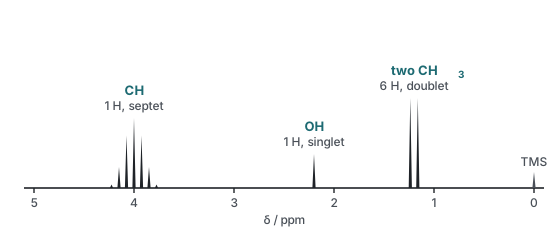
Worked exampleSplitting in propan-2-ol, (CH₃)₂CHOH
- Two CH₃ groups (6 H, δ about 1.2): the neighbouring carbon is the CH, with 1 H, so n = 1 and the peak is a doublet.
- CH (1 H, δ about 4.0): the neighbouring carbons are the two CH₃ groups with 6 H in total, so n = 6 and the peak is a septet. It is high because the carbon is bonded to O.
- OH (1 H, δ about 2.2): a singlet.
Some patterns appear so often that they are worth knowing on sight.
| Pattern in the spectrum | Group |
|---|---|
| a triplet (3 H) and a quartet (2 H) | an ethyl group, –CH₂CH₃ |
| a doublet (6 H) and a septet (1 H) | an isopropyl group, –CH(CH₃)₂ |
| a singlet (3 H) at about 2.0–2.1 | CH₃ next to C=O with no H on the next atom |
| a singlet (3 H) at about 3.7 | CH₃ bonded to O, as in a methyl ester |
Putting the evidence together 20.1
Every question of this kind has the same shape. The data come in pieces and each piece answers one question.
MethodSolving a structure
- Formula. Use the combustion or percentage data and the molecular ion to get the molecular formula.
- Functional groups. Use the chemical tests and the infrared spectrum. Note what is absent.
- Carbon skeleton. Use the number of ¹³C peaks and any peak above 160.
- Proton detail. Use the number of peaks, the shifts, the area ratio and the splitting.
- Check. Draw your structure and predict its spectra. Every peak must be accounted for.
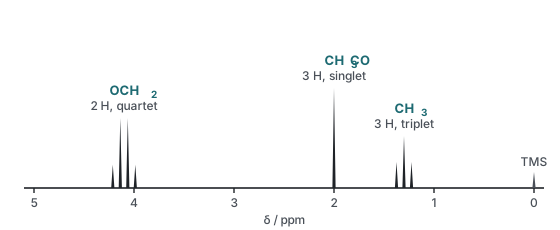
Worked exampleCompound Y, C₄H₈O₂
Illustrative data. Compound Y has = 88 and the formula C₄H₈O₂ (page 1). It does not react with sodium carbonate solution. The other evidence is in the table. Identify Y.
| Evidence | Deduction |
|---|---|
| no reaction with Na₂CO₃(aq) | not a carboxylic acid |
| IR: strong at 1740 cm⁻¹, no broad O–H | C=O present, no O–H, so likely an ester |
| ¹³C NMR: 4 peaks, one near 171 ppm | four different carbons; 171 is the C=O of an ester |
| ¹H NMR: δ 2.0, 3 H, singlet | CH₃ next to C=O with no H on the next atom: CH₃CO– |
| ¹H NMR: δ 4.1, 2 H, quartet | CH₂ bonded to O, with 3 H next door |
| ¹H NMR: δ 1.3, 3 H, triplet | CH₃ with 2 H next door |
The quartet and triplet are an ethyl group on oxygen, –OCH₂CH₃, and the singlet is CH₃CO–. Y is ethyl ethanoate, CH₃COOCH₂CH₃.
Check. Methyl propanoate, CH₃CH₂COOCH₃, has the same formula, but it would give a singlet of 3 H near 3.7 (OCH₃) and a quartet of 2 H near 2.3. Y has no singlet at 3.7, so it is not methyl propanoate.
Worked exampleCompound Q, C₄H₈O
Illustrative data. Compound Q has the formula C₄H₈O. Its infrared spectrum has a strong absorption at 1715 cm⁻¹ and nothing above 3000. Its ¹³C spectrum has 4 peaks, one at δ = 209. Its ¹H spectrum has peaks at δ 2.1 (3 H, singlet), δ 2.4 (2 H, quartet) and δ 1.0 (3 H, triplet). Identify Q.
- 1715 and no O–H: a C=O in an aldehyde or ketone.
- δ = 209 is in the 190–220 range for an aldehyde or ketone C=O. There is no peak at 9.4–10.0 in the proton spectrum, so there is no –CHO: Q is a ketone.
- The singlet at 2.1 (3 H) is CH₃CO–. The quartet (2 H) and triplet (3 H) are an ethyl group, next to the C=O.
- Q is butanone, CH₃COCH₂CH₃. It has four carbon environments, which matches the four ¹³C peaks.
Check yourself
- Predict the splitting of each proton peak in butanone, CH₃COCH₂CH₃, and give its area.
- Predict the splitting of each peak in the proton spectrum of ethanal, CH₃CHO.
- A compound C₃H₇Cl has a proton NMR spectrum with a doublet of area 6 and a septet of area 1. Identify it.
- A compound C₂H₄O₂ has two singlets in the ratio 3 : 1, at δ = 2.1 and δ = 11.5. Its infrared spectrum has a very broad absorption from 3300 to 2500 cm⁻¹ and one at 1710 cm⁻¹. Identify it.
- Compound R has = 88 and the formula C₄H₈O₂. Its infrared spectrum has a strong absorption at 1735 cm⁻¹ and no broad O–H. Its ¹³C spectrum has 4 peaks. Its ¹H spectrum has δ 1.1 (3 H, triplet), δ 2.3 (2 H, quartet) and δ 3.7 (3 H, singlet). Identify R and explain why it is not ethyl ethanoate.
- State the number of lines in the CH peak of propan-2-ol and the ratio of their heights, and explain where the number comes from.
Answers cover these until you have tried the questions
- CH₃ next to C=O: singlet, 3 H, no hydrogens on the C=O carbon. CH₂: quartet, 2 H, the CH₃ next door has 3 H. CH₃ of the ethyl group: triplet, 3 H, the CH₂ next door has 2 H.
- CH₃: doublet, 3 H, because the CHO carbon has 1 H. CHO: quartet, 1 H, because the CH₃ has 3 H.
- A doublet of 6 H is two equivalent CH₃ groups next to a single H, and a septet of 1 H is that CH next to six H: an isopropyl group, –CH(CH₃)₂. The compound is 2-chloropropane, (CH₃)₂CHCl.
- The very broad O–H and the C=O show a carboxylic acid. The singlet at 11.5 (1 H) is the acid O–H and the singlet at 2.1 (3 H) is a CH₃ with no neighbouring H. The compound is ethanoic acid, CH₃COOH.
- C=O and no O–H: an ester. The singlet of 3 H at 3.7 is OCH₃. The quartet (2 H) and triplet (3 H) are an ethyl group next to the C=O, CH₃CH₂CO–. R is methyl propanoate, CH₃CH₂COOCH₃. Ethyl ethanoate would show a singlet at about 2.0 and a quartet at about 4.1 (an OCH₂ group), and R has neither.
- 7 lines, in the ratio 1 : 6 : 15 : 20 : 15 : 6 : 1. The CH has n = 6 hydrogens on its two adjacent CH₃ groups, so it gives n + 1 = 7 lines.