Topic 20 · page 4 of 15
NMR: environments, shifts and areas
Carbon-13 and proton NMR both give one peak for each set of equivalent atoms. The number of peaks counts the environments, the chemical shift shows what each atom is next to, and for protons the peak areas give the ratio of hydrogen atoms.
Read first: Infrared and mass spectra
What NMR tells you 20.1
Nuclear magnetic resonance spectroscopy detects atoms whose nuclei act as tiny magnets, here carbon-13 and hydrogen-1 (a proton). The frequency at which each nucleus absorbs depends on the atoms around it. Atoms in the same environment absorb together and give one peak. A different environment gives a different peak.
The position of a peak is its chemical shift, δ, in parts per million (ppm), measured from the single peak of tetramethylsilane, TMS, which is given δ = 0. The scale runs from high δ on the left to 0 on the right. An atom next to an electronegative atom, such as O, or next to C=O, has a higher δ (further downfield).
Carbon-13 NMR 20.1
Count the carbon atoms that are not equivalent. Two carbons are equivalent when they are bonded to the same atoms in the same way, usually because of symmetry. Each environment gives one peak.
| Carbon environment | δ / ppm |
|---|---|
| C=O in aldehydes and ketones | 190–220 |
| C=O in carboxylic acids and esters | 160–185 |
| C=C and aromatic carbon | 90–150 |
| C–O in alcohols and esters | 50–90 |
| C–C in alkyl groups | 5–55 |
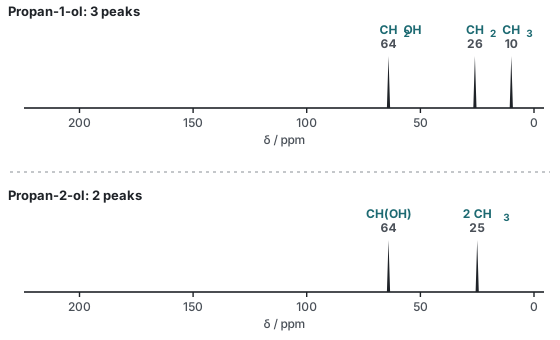
Propan-1-ol and propan-2-ol are isomers, and the number of peaks separates them.
| Compound | Carbon environments | Peaks | Shifts / ppm |
|---|---|---|---|
| propan-1-ol, CH₃CH₂CH₂OH | CH₂OH, CH₂, CH₃ | 3 | 64 (C–O), 26, 10 |
| propan-2-ol, CH₃CH(OH)CH₃ | CH(OH) and two equal CH₃ | 2 | 64 (C–O), 25 |
| ethyl ethanoate, CH₃COOCH₂CH₃ | C=O, OCH₂, CH₃CO, CH₃ | 4 | about 171, 60, 21, 14 |
| 2-methylpropan-2-ol, (CH₃)₃COH | C–OH and three equal CH₃ | 2 | about 69, 31 |
Proton NMR: shift and area 20.1
Hydrogen atoms in the same environment give one peak, and the three hydrogens of a CH₃ group count as one environment.
| Type of hydrogen | δ / ppm |
|---|---|
| carboxylic acid, –COOH | 10–12 |
| aldehyde, –CHO | 9.4–10.0 |
| CH₂ or CH₃ bonded to O | 3.3–4.3 |
| CH₂ or CH₃ next to C=O | 2.0–2.7 |
| CH₂ in a carbon chain | 1.2–1.4 |
| CH₃ at the end of a chain | 0.7–1.2 |
| O–H of an alcohol | variable, about 1–5 |
The area under each peak is proportional to the number of hydrogens in that environment. The areas are shown as an integration trace, a series of steps whose heights are in that ratio, or as numbers on each peak.
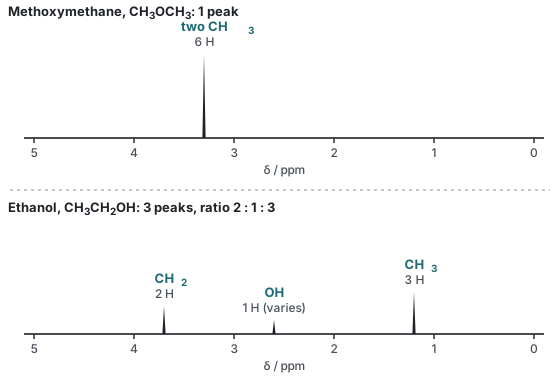
Compound X from page 1 has the formula C₂H₆O and can be ethanol or methoxymethane. Their proton spectra are very different.
| Compound | Hydrogen environments | Peaks | Area ratio (by δ, left to right) |
|---|---|---|---|
| methoxymethane, CH₃OCH₃ | six equivalent H | 1 | 6 |
| ethanol, CH₃CH₂OH | CH₂ (next to O), OH, CH₃ | 3 | 2 : 1 : 3 |
Worked exampleFrom an integration trace to a ratio
Illustrative data. The integration trace of an ester with molecular formula C₄H₈O₂ has three steps of height 2.4 cm (δ = 1.3), 2.4 cm (δ = 2.0) and 1.6 cm (δ = 4.1). Work out how many hydrogens give each peak.
- Divide by the smallest height, 1.6 cm: 1.5 : 1.5 : 1, which is 3 : 3 : 2 when doubled.
- The ratio adds up to 3 + 3 + 2 = 8 parts and the formula has 8 hydrogens, so each part is one hydrogen.
- The peaks are 3 H at δ = 1.3, 3 H at δ = 2.0 and 2 H at δ = 4.1.
- The 2 H peak at 4.1 is a CH₂ bonded to O. The 3 H peak at 2.0 is a CH₃ next to C=O.
Check yourself
- State the number of peaks in the carbon-13 NMR spectrum of (a) propanone, (b) butanone, (c) pentan-3-one, (d) 2-methylpropan-1-ol, (e) ethanoic acid.
- State the number of proton NMR peaks and their area ratio for (a) propanone, (b) propan-1-ol, (c) ethanal, (d) methyl propanoate, CH₃CH₂COOCH₃.
- A carbon-13 spectrum has peaks at δ = 205 and δ = 30. Assign the peaks and suggest a compound.
- A compound C₃H₆O has a proton NMR spectrum with three peaks in the ratio 3 : 2 : 1, one at δ = 9.8. Identify it.
- Explain why the OCH₂ hydrogens in ethyl ethanoate have a higher chemical shift than the CH₃ hydrogens of the ethyl group.
- The proton NMR integration trace of a compound C₄H₁₀O has two steps, of height 4.5 cm and 0.5 cm. How many hydrogens does each peak represent, and what is the compound?
Answers cover these until you have tried the questions
- (a) 2: C=O and two equivalent CH₃. (b) 4: all four carbons are different. (c) 3: C=O, two equivalent CH₂, two equivalent CH₃. (d) 3: two equivalent CH₃, CH, CH₂OH. (e) 2: CH₃ and COOH.
- (a) 1 peak; all 6 H are equivalent. (b) 4 peaks: CH₃ (3), CH₂ (2), CH₂O (2) and OH (1), ratio 3 : 2 : 2 : 1. (c) 2 peaks: CH₃ (3) and CHO (1), ratio 3 : 1. (d) 3 peaks: CH₃ of the ethyl group (3), CH₂ (2), OCH₃ (3), ratio 3 : 2 : 3.
- δ = 205 is in the 190–220 range: the C=O of an aldehyde or ketone. δ = 30 is in the 5–55 range: an alkyl carbon, here a CH₃. The compound could be propanone, CH₃COCH₃, which has just these two environments.
- δ = 9.8 is in the aldehyde range, 9.4–10.0, so a –CHO group is present. Three environments in the ratio 3 : 2 : 1 are CH₃, CH₂ and CHO, so the compound is propanal, CH₃CH₂CHO.
- The CH₂ is bonded to the electronegative oxygen atom, which pulls electron density away from the hydrogens, so they are less shielded and absorb at a higher δ. The CH₃ is bonded only to carbon and hydrogen, so its peak is at a low δ.
- The ratio 4.5 : 0.5 is 9 : 1, and 9 + 1 = 10, the number of hydrogens in the formula. So one peak is 9 H and the other is 1 H. Nine equivalent hydrogens are three CH₃ groups on the same carbon, and the single hydrogen is the O–H. The compound is 2-methylpropan-2-ol, (CH₃)₃COH.