Topic 20 · page 7 of 15
Grignard reagents and carbonyl compounds
A Grignard reagent adds its whole R group to the carbon of a C=O group. Methanal gives a primary alcohol, any other aldehyde a secondary alcohol and a ketone a tertiary alcohol, and you can work backwards from the alcohol to the reagents.
Read first: Grignard reagents and carbon dioxide
Adding R to a carbonyl carbon 20.2
The carbon of a C=O group is δ+, because oxygen is more electronegative. The δ− carbon of a Grignard reagent attacks it. The R group of the reagent bonds to the carbon of the carbonyl compound, and the C=O oxygen ends up as an alkoxide, –O–MgBr. Dilute acid then turns that into an –OH.
The addition takes place in dry ether, and the dilute acid is added at the end.
MethodGrignard reagent with a carbonyl compound
- Make R–MgX from the halogenoalkane, magnesium and dry ether.
- Add the aldehyde or ketone in dry ether.
- Add dilute acid to release the alcohol.
The product is an alcohol with more carbons. The new molecule has all the carbons of the Grignard reagent plus all the carbons of the carbonyl compound.
Which alcohol is made? 20.2
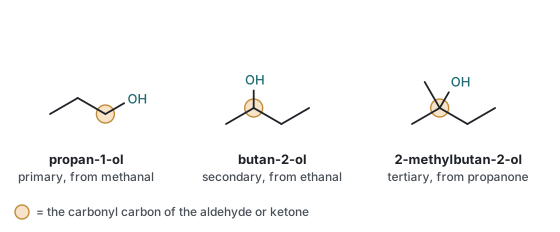
The class of the alcohol is set by the carbonyl compound. Count the number of carbon atoms bonded to the C–OH carbon in the product.
| Carbonyl compound | Alcohol formed | Example with CH₃CH₂MgBr |
|---|---|---|
| methanal, | primary | propan-1-ol, CH₃CH₂CH₂OH |
| any other aldehyde, for example ethanal, CH₃CHO | secondary | butan-2-ol, CH₃CH₂CH(OH)CH₃ |
| a ketone, for example propanone, CH₃COCH₃ | tertiary | 2-methylbutan-2-ol, CH₃CH₂C(OH)(CH₃)₂ |
Working backwards from an alcohol 20.2
To make a target alcohol, find its C–OH carbon. That carbon was the carbonyl carbon. Each group on it, apart from the –OH and H, is either R from the Grignard reagent or part of the carbonyl compound. Choose one group to come from the reagent and the rest from the carbonyl compound.
Worked examplePlanning the synthesis of butan-2-ol
- Butan-2-ol is CH₃CH(OH)CH₂CH₃. The C–OH carbon has one H and two carbon groups, so it is a secondary alcohol and came from an aldehyde.
- Route A: CH₃ comes from the Grignard reagent, CH₃MgBr (from bromomethane), and CH₃CH₂CHO (propanal) is the aldehyde.
- Route B: CH₃CH₂ comes from CH₃CH₂MgBr (from bromoethane), and CH₃CHO (ethanal) is the aldehyde.
- Either route is correct. Each gives four carbons in total: 1 + 3 for route A and 2 + 2 for route B.
Worked examplePlanning the synthesis of 2-methylpropan-2-ol
- (CH₃)₃COH is a tertiary alcohol, so it came from a ketone.
- The C–OH carbon carries three identical CH₃ groups. One is from the reagent, CH₃MgBr, and two are in the ketone, propanone, CH₃COCH₃.
- Only one route is possible, because all three groups are the same.
Check yourself
- Give the reagents and conditions to convert bromomethane into propan-2-ol via a Grignard reagent. Name the carbonyl compound.
- Which Grignard reagent and which carbonyl compound give pentan-3-ol, CH₃CH₂CH(OH)CH₂CH₃?
- Which Grignard reagent and carbonyl compound give 2-methylpropan-2-ol?
- Name the alcohol formed when CH₃CH₂CH₂MgBr reacts with methanal, then dilute acid, and classify it.
- A student carried out step 2 of a Grignard synthesis with ether that had not been dried. Explain why the yield was very low.
- Suggest why a tertiary alcohol cannot be made by a Grignard reagent and an aldehyde.
Answers cover these until you have tried the questions
- Mg in dry ether gives CH₃MgBr. Add ethanal, CH₃CHO, in dry ether, then dilute acid. The product is CH₃CH(OH)CH₃, propan-2-ol. (1 C from the reagent plus 2 C in ethanal = 3 C.)
- The C–OH carbon has one H and two ethyl groups. Use CH₃CH₂MgBr and propanal, CH₃CH₂CHO. Both halves are ethyl groups, so there is one route.
- CH₃MgBr and propanone, CH₃COCH₃, in dry ether, then dilute acid.
- Butan-1-ol, CH₃CH₂CH₂CH₂OH: three carbons from the Grignard reagent and one from methanal. It is a primary alcohol, because methanal has no R groups.
- Water in the ether reacts with the Grignard reagent, , so less reagent is left to react with the carbonyl compound.
- An aldehyde has only one R group (or H) on its C=O carbon, so the product has one R group from the aldehyde and one from the reagent: two carbon groups on the C–OH carbon, which is secondary. A tertiary alcohol needs three carbon groups, so it needs a ketone.