Topic 20 · page 13 of 15
Recrystallisation, melting and boiling temperatures
A solid is purified by recrystallisation from a hot solvent, and its purity is checked by its melting temperature. A liquid is checked by its boiling temperature. A pure compound melts or boils sharply at the value in the data book.
Read first: Drying, distillation and steam distillation
Recrystallisation 20.5(iv)
A solid product from a preparation is contaminated with by-products and unreacted starting material. Recrystallisation purifies it. The idea is simple: the impure solid is dissolved in a hot solvent and the solution is cooled. The wanted compound is much less soluble when cold, so it crystallises out. The impurities are present in small amounts and stay dissolved.
| Step | Reason |
|---|---|
| Dissolve the solid in the minimum volume of hot solvent | the solution is saturated, so most of the product crystallises when cooled |
| Filter the hot solution, if solid specks remain | removes insoluble impurities; hot, so the product does not crystallise in the funnel |
| Cool slowly, then in ice | large crystals form; the product crystallises and the soluble impurities stay in solution |
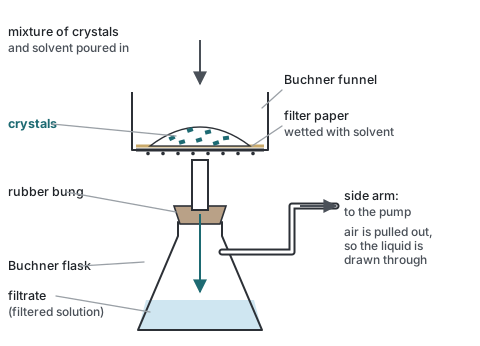
| Filter under reduced pressure | a fast, thorough separation of the crystals |
| Wash with a little ice-cold solvent | washes off the solution of impurities without dissolving much product |
| Dry the crystals between filter papers, in a desiccator or in a low oven | removes the solvent, so the mass and melting temperature are correct |
Worked examplePercentage recovery
Illustrative data. 2.60 g of crude aspirin gives 2.10 g of pure crystals after recrystallisation. Calculate the percentage recovery.
- Percentage recovery = (mass of pure crystals ÷ mass of crude solid) × 100.
- = 2.10 ÷ 2.60 × 100 = 80.8%.
- The recovery is below 100% because some product stays dissolved in the cold solvent and some is lost on the filter paper and in the glassware.
Melting temperature determination 20.5(viii)
A pure solid melts at a fixed temperature. An impure solid melts lower than the pure value, and over a range. So the melting temperature shows both the identity and the purity of a solid.
PracticalMeasuring a melting temperature
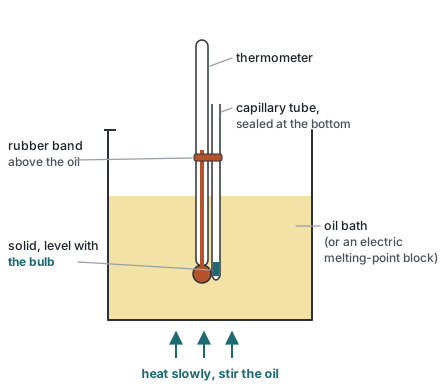
- Fill a capillary tube, sealed at one end, with a few millimetres of dry, powdered solid.
- Attach the tube to a thermometer with a rubber band, with the solid level with the thermometer bulb. Keep the rubber band above the level of the oil.
- Heat the oil bath slowly, stirring, especially near the expected melting temperature.
- Record the temperature when the first liquid appears and the temperature when all the solid has melted. This is the melting range.
| What you find | What it means |
|---|---|
| a sharp range of about 1–2 °C, matching the data book | the solid is pure |
| melts lower than the data-book value and over a wide range | the solid is impure |
| a sharp range that is not the data-book value | a different compound |
Worked exampleJudging purity from melting ranges
Illustrative data. The data book gives about 136 °C for aspirin. A crude sample melts at 128–133 °C. After recrystallisation the product melts at 134–136 °C.
- The crude sample melts below 136 °C and over a 5 °C range: it is impure.
- The recrystallised sample melts over 2 °C, close to 136 °C: it is much purer.
- A range that is still a little low shows that traces of impurity remain. Recrystallise again, and dry the crystals thoroughly.
Boiling temperature determination 20.5(ix)
A pure liquid boils at a fixed temperature at a given pressure. An impure liquid boils over a range and often at a different temperature.
To measure it, distil the liquid with the thermometer bulb level with the side arm (page 12) and record the temperature that stays steady while the liquid distils. Compare it with the value in the data book.
| What you find | What it means |
|---|---|
| a steady temperature that matches the data book | the liquid is pure |
| a temperature that rises over several degrees | a mixture of liquids |
| a steady temperature that is not the data-book value | a different compound |
Check yourself
- Explain why the minimum volume of hot solvent is used in a recrystallisation.
- Why is the crystal filtered under reduced pressure, and then washed with ice-cold solvent?
- A sample of aspirin melts at 128–133 °C. What does this show, and how could it be improved?
- Why is the oil bath heated slowly near the melting temperature?
- A liquid distils at a steady 78 °C. The data book says that pure ethanol boils at 78 °C. A second liquid distils between 80 and 86 °C. What do the results suggest in each case?
- Describe how you would purify an impure solid by recrystallisation, and say how you would show that it is pure.
Answers cover these until you have tried the questions
- A minimum volume gives a solution that is saturated at the boiling temperature, so most of the product crystallises on cooling. Extra solvent leaves product in solution, and the yield falls. The solvent is hot so that the compound dissolves.
- Reduced pressure pulls the liquid through quickly and leaves the crystals dry. The ice-cold solvent washes off the impure solution, and the low temperature means very little product dissolves.
- The sample is impure: it melts below the pure value of about 136 °C and over a 5 °C range. Recrystallise it from the minimum volume of hot solvent, filter, wash with ice-cold solvent, dry, and measure the melting temperature again.
- The thermometer lags behind the sample. Heating quickly gives a reading that is too high and a range that is too wide, so the true melting range is missed.
- The first is a pure liquid, because it boils at a steady temperature that matches the data book. The second boils over a range, which suggests a mixture (or impure liquid).
- Dissolve in the minimum volume of hot solvent; filter hot if solid specks remain; cool slowly then in ice; filter under reduced pressure; wash with a little ice-cold solvent; dry. To test purity, measure the melting range: a narrow range that matches the data-book value shows the solid is pure.