Topic 18 · page 9 of 10
Phenol and bromine water
Phenol decolourises bromine water at room temperature and gives a white precipitate of 2,4,6-tribromophenol. A lone pair on oxygen is partly delocalised into the ring, so the ring is more electron rich than benzene's.
Read first: Why benzene resists bromination, Electrophilic substitution and bromination
The reaction 18.6
Phenol is C₆H₅OH: a benzene ring with an –OH group bonded directly to it. It reacts with bromine water at room temperature with no catalyst:
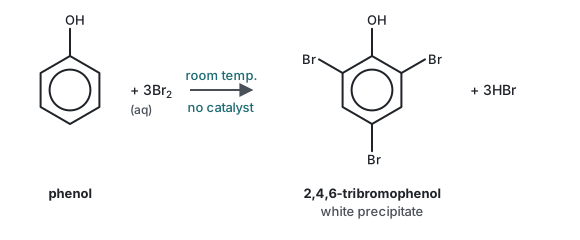
The three bromine atoms replace three hydrogen atoms on the ring, at the positions numbered 2, 4 and 6. The carbon carrying the –OH group is position 1. The product is 2,4,6-tribromophenol.
Observations:
- the orange bromine water is decolourised,
- a white precipitate forms.
Compare benzene, which needs liquid bromine and a catalyst, and substitutes once.
| Add bromine water to… | Observation | Reaction |
|---|---|---|
| cyclohexene | orange to colourless, no precipitate | electrophilic addition |
| benzene | no change, stays orange | none |
| aqueous phenol | orange to colourless, white precipitate | electrophilic substitution (three times) |
Why phenol reacts so easily 18.6
The oxygen atom in phenol has lone pairs. One lone pair is in a p-orbital that points at right angles to the ring, just like the p-orbitals on the ring carbons. It overlaps with the ring's π system, so the lone pair is partly delocalised into the ring.
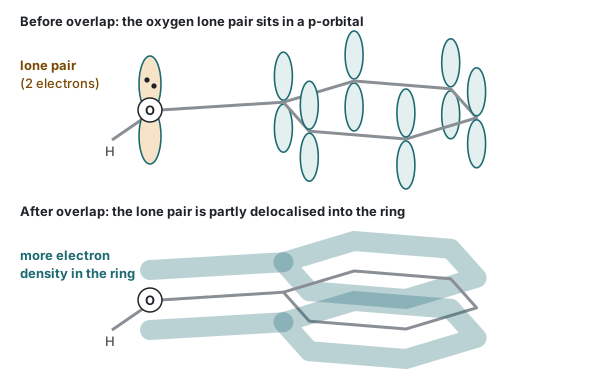
This increases the electron density in the ring. A ring with higher electron density can polarise a bromine molecule (induce a dipole in Br₂) without help, as an alkene does. So phenol reacts with bromine water at room temperature, with no catalyst. The ring is so electron rich that three bromine atoms enter, one at each of positions 2, 4 and 6.
Worked exampleMass of 2,4,6-tribromophenol
What mass of 2,4,6-tribromophenol forms from 1.88 g of phenol with excess bromine water, and what mass of bromine is needed? (Illustrative data.)
- M(C₆H₅OH) = 6 × 12.0 + 6 × 1.0 + 16.0 = 94.0 g mol⁻¹, so n = 1.88 ÷ 94.0 = 0.0200 mol
- Ratio 1 : 1, so n(C₆H₂Br₃OH) = 0.0200 mol
- M(C₆H₂Br₃OH) = 72.0 + 3.0 + 3 × 79.9 + 16.0 = 330.7 g mol⁻¹, so mass = 0.0200 × 330.7 = 6.61 g
- Ratio phenol : Br₂ = 1 : 3, so n(Br₂) = 0.0600 mol, mass = 0.0600 × 159.8 = 9.59 g
Check yourself
- Write the equation for the reaction of phenol with bromine water and give two observations.
- State the reagents and conditions for the bromination of benzene, and compare them with those for phenol.
- Explain why phenol reacts with bromine more readily than benzene does.
- Describe how you could distinguish cyclohexene, benzene and aqueous phenol using bromine water.
- What mass of 2,4,6-tribromophenol forms from 0.470 g of phenol with excess bromine water?
- Why does phenol give a tribromo product when benzene gives only a monobromo product?
Answers cover these until you have tried the questions
- . The bromine water is decolourised (orange to colourless) and a white precipitate forms.
- Benzene needs liquid bromine and an FeBr₃ catalyst. Phenol reacts with bromine water, at room temperature, with no catalyst.
- A lone pair on the oxygen is in a p-orbital that overlaps with the π system of the ring, so it is partly delocalised into the ring. This increases the electron density of the ring, so the ring polarises bromine molecules more easily. Benzene's electron density is lower, so it needs a catalyst to make a stronger electrophile.
- Add bromine water to each. Cyclohexene: decolourised, no precipitate. Benzene: no change, remains orange. Phenol: decolourised and a white precipitate.
- n(phenol) = 0.470 ÷ 94.0 = 0.00500 mol = n(product). m = 0.00500 × 330.7 = 1.6535, so 1.65 g.
- The oxygen lone pair delocalised into the ring makes the ring so electron rich that it reacts with bromine water readily, and substitution continues until positions 2, 4 and 6 all carry bromine. Benzene's ring has much lower electron density, so it needs a strong electrophile made with a catalyst, and under those conditions only one bromine atom is added.