Topic 18 · page 5 of 10
Reactions of benzene at a glance
Benzene burns with a smoky flame, and reacts by substitution with five reagent combinations. Know the reagents, conditions and organic product of each, then learn how they work.
Read first: Why benzene resists bromination
The reactions in this topic 18.4
The specification limits the reactions of benzene to one combustion reaction and four types of substitution. Page 5 is the map. Pages 6 to 8 explain each reaction.
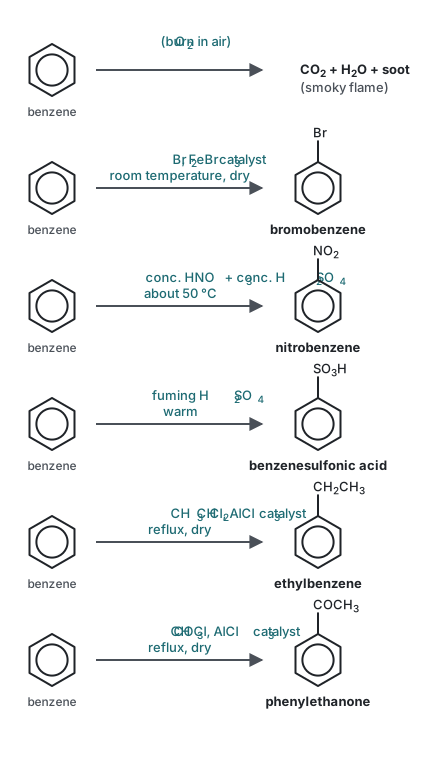
| Reaction | Reagents | Conditions | Organic product |
|---|---|---|---|
| combustion | oxygen in air | burn | CO₂ and H₂O, with soot |
| bromination | Br₂ and an FeBr₃ catalyst | room temperature, dry | bromobenzene, C₆H₅Br |
| nitration | concentrated HNO₃ and concentrated H₂SO₄ | about 50 °C | nitrobenzene, C₆H₅NO₂ |
| sulfonation | fuming sulfuric acid | warm | benzenesulfonic acid, C₆H₅SO₃H |
| Friedel-Crafts alkylation | halogenoalkane, AlCl₃ catalyst | heat under reflux, dry | alkylbenzene, such as ethylbenzene |
| Friedel-Crafts acylation | acyl chloride, AlCl₃ catalyst | heat under reflux, dry | aromatic ketone, such as phenylethanone |
In every substitution one hydrogen atom on the ring is replaced and the ring survives. The products of halogenation, nitration and the two Friedel-Crafts reactions all form by one mechanism, covered next.
Combustion and the smoky flame 18.4
Benzene burns in air. With plenty of oxygen, combustion is complete:
Benzene is a hydrocarbon with a high carbon to hydrogen ratio, one carbon for each hydrogen. In an ordinary flame there is not enough oxygen for all that carbon to burn completely, so combustion is incomplete. Unburnt carbon is released as soot, and the glowing particles make the flame yellow and smoky.
Carbon monoxide can also form in incomplete combustion. It is toxic.
The proportion of carbon by mass shows why benzene is smoky:
| Hydrocarbon | Formula | Carbon by mass |
|---|---|---|
| hexane | C₆H₁₄ | 72.0 ÷ 86.0 = 83.7% |
| cyclohexene | C₆H₁₀ | 72.0 ÷ 82.0 = 87.8% |
| benzene | C₆H₆ | 72.0 ÷ 78.0 = 92.3% |
Worked exampleComplete combustion of benzene
What volume of oxygen at RTP, and what mass of carbon dioxide, results from the complete combustion of 1.00 g of benzene?
- n(C₆H₆) = 1.00 ÷ 78.0 = 0.01282 mol
- From the equation C₆H₆ + 7½O₂ → 6CO₂ + 3H₂O, n(O₂) = 7.5 × 0.01282 = 0.09615 mol
- V(O₂) = 0.09615 × 24.0 = 2.31 dm³
- n(CO₂) = 6 × 0.01282 = 0.07692 mol, so m(CO₂) = 0.07692 × 44.0 = 3.38 g
Benzene is carcinogenic. In school, a demonstration of the smoky flame uses a small sample of an arene such as methylbenzene, in a fume cupboard.
Check yourself
- Write the equation for the complete combustion of one mole of benzene.
- Explain why benzene burns with a smoky flame, but hexane burns with a cleaner one.
- 0.390 g of benzene burns completely in excess oxygen. Calculate the volume of oxygen used, at RTP, and the mass of carbon dioxide formed.
- Give the reagents and the organic product for (a) nitration, (b) sulfonation, (c) bromination of benzene.
- What type of reaction do all of the reactions in the table (apart from combustion) have in common?
Answers cover these until you have tried the questions
- One mole needs 7½ mol of oxygen, so it is neater to write two moles:
- Benzene's carbon to hydrogen ratio is 1 : 1 (92.3% carbon by mass), much higher than hexane's (83.7%). There is not enough oxygen for all of the carbon, so combustion is incomplete and unburnt carbon (soot) is released, giving a smoky flame.
- n(C₆H₆) = 0.390 ÷ 78.0 = 0.00500 mol. n(O₂) = 7.5 × 0.00500 = 0.0375 mol, so V = 0.0375 × 24.0 = 0.900 dm³. n(CO₂) = 6 × 0.00500 = 0.0300 mol, so m = 0.0300 × 44.0 = 1.32 g.
- (a) Concentrated HNO₃ and concentrated H₂SO₄, giving nitrobenzene. (b) Fuming sulfuric acid, giving benzenesulfonic acid. (c) Br₂ with an FeBr₃ catalyst, giving bromobenzene.
- Electrophilic substitution (one H on the ring is replaced). The mechanism of sulfonation is not required.