Topic 18 · page 3 of 10
The delocalised model
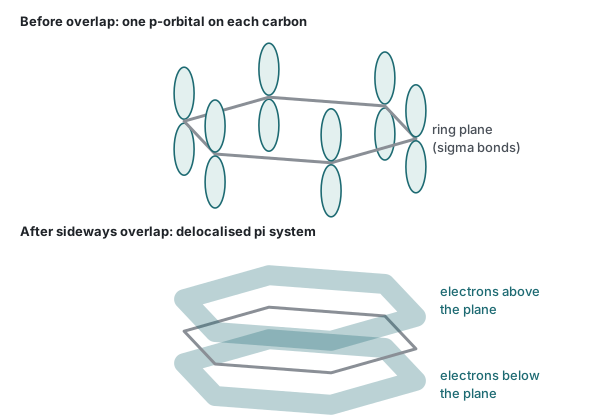
Each carbon in benzene has a p-orbital at right angles to the ring. They overlap sideways into one π system of six delocalised electrons above and below the plane.
Read first: Bond lengths and infrared evidence
The σ framework 18.2
Each carbon atom has four outer electrons. In benzene it uses three of them to form σ bonds:
- one σ bond to a hydrogen atom,
- one σ bond to each of its two neighbouring carbon atoms.
Three regions of electron density repel equally, so they sit as far apart as possible: in one plane, at 120° to each other. The six carbons and six hydrogens therefore form a flat, regular hexagonal skeleton.
The p-orbitals and the π system 18.2
Each carbon still has one outer electron left. It sits in a p-orbital, a dumb-bell shaped region with one lobe above the ring and one below. The p-orbital points at right angles to the plane of the ring.
Neighbouring p-orbitals overlap sideways. In benzene every p-orbital overlaps with the p-orbitals on both of its neighbours, so the overlap runs all the way round the ring. This gives π bonding that is not confined to any pair of carbons.
The result is a ring of π electron density above the plane and another below the plane. The six p electrons (one from each carbon) are shared by all six carbons.
Compare this with ethene. There, each carbon's p-orbital overlaps with one neighbour only, so the two π electrons are localised between those two carbons. That is the difference the next page needs.
How the model explains the evidence 18.118.2
Each piece of evidence from the last two pages follows from the model.
| Evidence | Explanation from the delocalised model |
|---|---|
| all six C–C bonds are 0.139 nm | the π electron density is shared evenly round the ring, so every bond is identical and partly double |
| bond angles are 120°, planar hexagon | each carbon has three σ bonds in a plane, and the p-orbitals are all parallel |
| 152 kJ mol⁻¹ extra stability | the π electrons are attracted by six nuclei, not two, which lowers the energy of the molecule |
| no alkene C=C peak in the infrared | there are no localised C=C bonds, only delocalised π bonding |
Check yourself
- Why are the bond angles in benzene 120°?
- How many electrons are delocalised in benzene, and where do they come from?
- Describe how the π bonds in benzene are formed.
- Use the delocalised model to explain why all the C–C bond lengths in benzene are equal.
- State one difference between the π bond in ethene and the π system in benzene.
Answers cover these until you have tried the questions
- Each carbon has three σ bonds (two C–C, one C–H). Three regions of electron density repel equally, so they lie in one plane at 120° (trigonal planar).
- Six: each of the six carbon atoms contributes one electron from its p-orbital.
- Each carbon has a p-orbital at right angles to the plane of the ring, holding one electron. Each p-orbital overlaps sideways with the p-orbitals on both neighbouring carbons. This forms π bonding that extends round the whole ring, with a ring of delocalised electron density above and below the plane.
- The π electron density is spread evenly round the ring, because every p-orbital overlaps equally with both neighbours. So all six bonds are identical, partly double in character, and intermediate in length.
- In ethene the π electrons are localised between two carbon atoms. In benzene they are delocalised over all six carbon atoms.