Topic 18 · page 8 of 10
Friedel-Crafts reactions
A halogenoalkane or an acyl chloride, with an AlCl₃ catalyst, joins a carbon group to the benzene ring. The catalyst makes a carbocation or an acylium ion, which is the electrophile.
Read first: Electrophilic substitution and bromination
Two Friedel-Crafts reactions 18.4
A Friedel-Crafts reaction forms a new C–C bond between the benzene ring and a carbon group. There are two types, both using anhydrous aluminium chloride, AlCl₃, as the catalyst:
| Alkylation | Acylation | |
|---|---|---|
| reagent | a halogenoalkane, RCl | an acyl chloride, RCOCl |
| example | chloroethane, CH₃CH₂Cl | ethanoyl chloride, CH₃COCl |
| organic product | an alkylbenzene | an aromatic ketone |
| example product | ethylbenzene, C₆H₅CH₂CH₃ | phenylethanone, C₆H₅COCH₃ |
| by-product | HCl | HCl |
Conditions for both: heat under reflux, with dry apparatus and reagents.
Alkylation:
Acylation:
The hydrogen chloride is the by-product, not chlorine.
Generating the electrophile 18.5
AlCl₃ is electron-deficient: the aluminium atom has only six electrons in its outer shell. It accepts a lone pair from a chlorine atom in the halogenoalkane or acyl chloride, and pulls the chloride off. This leaves a positive ion, the electrophile:
The ion CH₃CH₂⁺ is a carbocation. The ion CH₃CO⁺ is an acylium ion. Once formed, either attacks the ring in the same two steps as before.
The mechanism 18.5
The first curly arrow goes from the ring to the positively charged carbon of the electrophile. For the acylium ion that is the carbon of C=O. Here is acylation with E = CH₃CO.
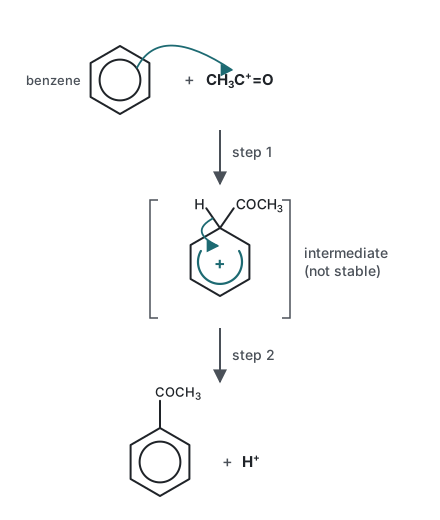
For alkylation, write the same mechanism with CH₃CH₂⁺ as the electrophile. The ring is joined through the CH₂ carbon, giving ethylbenzene.
Regenerating the catalyst
The AlCl₃ is regenerated, and the by-product HCl is formed.
Worked exampleAcylation with propanoyl chloride
Write the equation, the formation of the electrophile and the product for benzene reacting with propanoyl chloride, CH₃CH₂COCl, and AlCl₃.
- Electrophile:
- Curly arrow from the ring to the carbonyl carbon of CH₃CH₂CO⁺. The intermediate has a horseshoe over five carbons, + inside, and H and CH₃CH₂CO on the sixth.
- Curly arrow from the C–H bond back into the ring, losing H⁺. Catalyst regenerated:
- Overall: . The product is 1-phenylpropan-1-one, a ketone.
Worked exampleAtom economy of making phenylethanone
Calculate the atom economy of the acylation of benzene with ethanoyl chloride, C₆H₆ + CH₃COCl → C₆H₅COCH₃ + HCl.
- M(C₆H₅COCH₃) = 8 × 12.0 + 8 × 1.0 + 16.0 = 120.0 g mol⁻¹
- M(HCl) = 1.0 + 35.5 = 36.5 g mol⁻¹
- Atom economy = 120.0 ÷ (120.0 + 36.5) × 100 = 120.0 ÷ 156.5 × 100 = 76.7%
Check yourself
- Name the organic product and write the equation for the reaction of benzene with chloroethane and AlCl₃.
- Give the reagents and conditions needed to make phenylethanone from benzene.
- Explain how AlCl₃ acts as a catalyst in a Friedel-Crafts reaction.
- Why must the apparatus be dry?
- Calculate the atom economy of making ethylbenzene from benzene and chloroethane, C₆H₆ + CH₃CH₂Cl → C₆H₅CH₂CH₃ + HCl.
- Outline the mechanism for the reaction of benzene with ethanoyl chloride and AlCl₃, including the formation of the electrophile.
Answers cover these until you have tried the questions
- Ethylbenzene.
- Ethanoyl chloride, CH₃COCl, and anhydrous aluminium chloride catalyst, heated under reflux in dry conditions.
- The aluminium atom in AlCl₃ is electron-deficient, so it accepts a lone pair from chlorine and pulls Cl⁻ off the reagent, forming the electrophile and AlCl₄⁻. After the ring loses H⁺, regenerates AlCl₃.
- AlCl₃ reacts with water, so the catalyst would be destroyed. Acyl chlorides also react with water.
- M(C₆H₅CH₂CH₃) = 8 × 12.0 + 10 × 1.0 = 106.0. M(HCl) = 36.5. Atom economy = 106.0 ÷ (106.0 + 36.5) × 100 = 106.0 ÷ 142.5 × 100 = 74.4%.
- Electrophile: . Curly arrow from the ring to the carbon of CH₃CO⁺. Intermediate: horseshoe over five carbons, + inside, H and CH₃CO on the sixth carbon. Curly arrow from the C–H bond back into the ring, losing H⁺. Product: phenylethanone. Catalyst regenerated: