Topic 18 · page 7 of 10
Nitration and sulfonation
Concentrated nitric and sulfuric acids make the nitronium ion NO₂⁺, which substitutes into benzene to give nitrobenzene. Fuming sulfuric acid gives benzenesulfonic acid; you need its reagents and product, not its mechanism.
Read first: Electrophilic substitution and bromination
Nitration of benzene 18.418.5
Benzene reacts with a mixture of concentrated nitric acid and concentrated sulfuric acid at about 50 °C. The product is nitrobenzene, which has the nitro group –NO₂ in place of one H.
The temperature must stay below about 55 °C. At higher temperatures more than one nitro group is added to the ring, which lowers the yield of nitrobenzene.
Generating the electrophile
The electrophile is the nitronium ion, NO₂⁺. Sulfuric acid is the stronger acid, so it protonates nitric acid, which then loses water:
An equivalent two-step version is also accepted: , followed by .
The mechanism
Follow the general pattern with E = NO₂. The bond to the ring forms from the nitrogen atom of NO₂⁺.
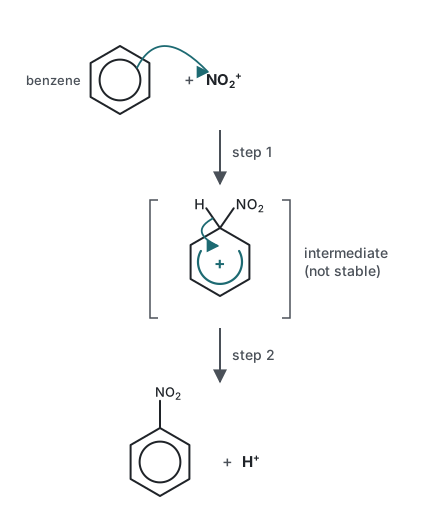
Regenerating the catalyst
Sulfuric acid is a catalyst. The H⁺ lost in step 2 reacts with HSO₄⁻:
Worked examplePercentage yield of nitrobenzene
7.80 g of benzene is nitrated and 9.10 g of nitrobenzene is obtained (illustrative data). Calculate the percentage yield.
- M(C₆H₆) = 78.0 g mol⁻¹, so n(C₆H₆) = 7.80 ÷ 78.0 = 0.100 mol
- 1 : 1 ratio, so the theoretical n(C₆H₅NO₂) = 0.100 mol
- M(C₆H₅NO₂) = 6 × 12.0 + 5 × 1.0 + 14.0 + 2 × 16.0 = 123.0 g mol⁻¹, so theoretical mass = 0.100 × 123.0 = 12.3 g
- Percentage yield = 9.10 ÷ 12.3 × 100 = 74.0%
Sulfonation of benzene 18.4
Benzene reacts with fuming sulfuric acid, which is concentrated sulfuric acid with extra sulfur trioxide dissolved in it, when warmed. The product is benzenesulfonic acid, which has the sulfonic acid group –SO₃H in place of one H.
Using the sulfur trioxide in the mixture, the equation is .
Check yourself
- Give the reagents and conditions needed to convert benzene into nitrobenzene.
- Write an equation for the formation of the electrophile in this reaction. Name the electrophile.
- Why must the temperature be kept below about 55 °C?
- Show that sulfuric acid is a catalyst in the nitration of benzene.
- 15.6 g of benzene is nitrated and 17.2 g of nitrobenzene is obtained (illustrative data). Calculate the percentage yield.
- State the reagent, condition and product for the sulfonation of benzene.
Answers cover these until you have tried the questions
- Concentrated nitric acid and concentrated sulfuric acid, at about 50 °C.
- . The electrophile is the nitronium ion, NO₂⁺.
- Above about 55 °C more than one nitro group substitutes onto the ring, so the yield of nitrobenzene falls.
- It is used to make the electrophile and regenerated at the end: . Overall, it is not used up.
- n(C₆H₆) = 15.6 ÷ 78.0 = 0.200 mol. Theoretical mass of nitrobenzene = 0.200 × 123.0 = 24.6 g. Percentage yield = 17.2 ÷ 24.6 × 100 = 69.9%.
- Fuming sulfuric acid, warm. The product is benzenesulfonic acid, C₆H₅SO₃H.