Topic 7 · page 11 of 14
Water as a solvent for ionic compounds
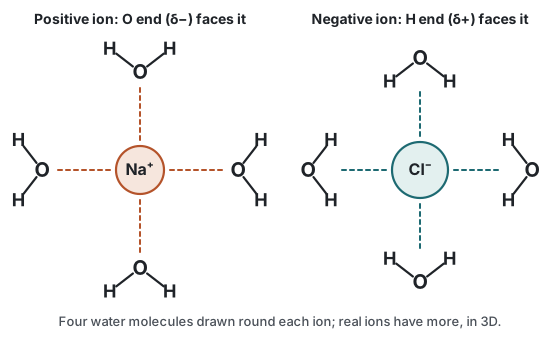
Water molecules are polar. They surround each ion of an ionic solid, with the δ− oxygen towards positive ions and the δ+ hydrogens towards negative ions. This is hydration, and the energy released pays for breaking up the lattice.
Read first: Hydrogen bonds
Hydration of ions 7.67.6(i)
A solvent is a liquid that dissolves a solute. The choice of solvent depends on the forces in the solute and in the solvent. Think of dissolving as swapping attractions: some are broken, and new ones are formed. This page does it for an ionic solid in water. The rest of the solvents section does it for other substances.
A water molecule is polar: its O atom is δ− and its two H atoms are δ+. In sodium chloride, Na⁺ and Cl⁻ ions are held in a lattice by strong attractions between oppositely charged ions. When the solid is put in water:
- Water molecules are attracted to the ions at the surface of the crystal. Each δ− oxygen is attracted to a Na⁺ ion, and each δ+ hydrogen is attracted to a Cl⁻ ion.
- These attractions pull the ions out of the lattice, one by one.
- Each ion ends up surrounded by water molecules, which hold it in solution. The ions are hydrated.
The equation for dissolving sodium chloride shows the result: the lattice is replaced by separate ions in water.
(aq) means that the ions are hydrated: surrounded by water molecules.
Why it dissolves 7.67.6(i)
Dissolving needs energy to pull ions out of the lattice (and to push water molecules apart a little). It releases energy when the water molecules bond to the ions. A salt dissolves when the energy released by hydration is large enough to make up for the energy needed to break up the lattice.
Not every ionic compound dissolves. In barium sulfate or calcium carbonate the lattice attractions are so strong that the energy released by hydration is not enough to make up for them, so these compounds are insoluble.
Worked exampleExplain why sodium chloride dissolves in water
- Water molecules are polar: O is δ−, H is δ+.
- The δ− oxygen atoms are attracted to the Na⁺ ions and the δ+ hydrogen atoms to the Cl⁻ ions at the surface of the lattice.
- The ions are pulled out of the lattice and surrounded by water molecules: they are hydrated.
- The energy released when the ions are hydrated makes up for the energy needed to break the ionic attractions in the lattice, so the solid dissolves.
Check yourself
- Define hydration of ions.
- Which end of a water molecule points at a Mg²⁺ ion, and which at a Br⁻ ion? Explain.
- Write an equation with state symbols for magnesium chloride dissolving in water.
- Explain why sodium chloride dissolves in water.
- Barium sulfate is insoluble in water. Suggest, in terms of energy, why.
- A student writes: "Sodium chloride dissolves because water breaks the ionic bonds." Add what is missing for full marks.
Answers cover these until you have tried the questions
- The surrounding of ions by water molecules, held by attraction between the ion and the oppositely charged end of the polar water molecules.
- Mg²⁺: the O end (δ−) points at it, because opposite charges attract. Br⁻: the H end (δ+) points at it, for the same reason.
- MgCl₂(s) → Mg²⁺(aq) + 2Cl⁻(aq)
- Water is polar, with δ− O and δ+ H. The δ− O atoms are attracted to Na⁺ and the δ+ H atoms to Cl⁻, which pulls the ions out of the lattice and surrounds them (hydration). The energy released by hydration makes up for the energy needed to break the lattice, so the solid dissolves.
- The attractions between the ions in the lattice are so strong that the energy released when the ions are hydrated is not enough to make up for the energy needed to break the lattice.
- Water does not just break the ionic attractions. The ions are attracted by the polar water molecules (δ− O to Na⁺, δ+ H to Cl⁻) and hydrated, and the energy released on hydration makes up for the energy needed to break the lattice.