Topic 7 · page 2 of 14
London forces
Electrons keep moving, so for an instant one end of a molecule is slightly negative and the other slightly positive. That instantaneous dipole induces a dipole in the next molecule, and the two attract. Every molecule has London forces.
Read first: Forces between molecules
Where London forces come from 7.17.1(i)
Methane, CH₄, has no permanent dipole, yet it becomes a liquid at −162 °C. Something must hold its molecules together. That something is the London force, and it is present between all molecules, polar or not.
The electrons in a molecule are not fixed in place. They move all the time. On average the electron cloud is spread evenly, so the molecule has no permanent dipole. But at any one instant the electrons may be a little more on one side than the other. Follow the four steps in the figure.
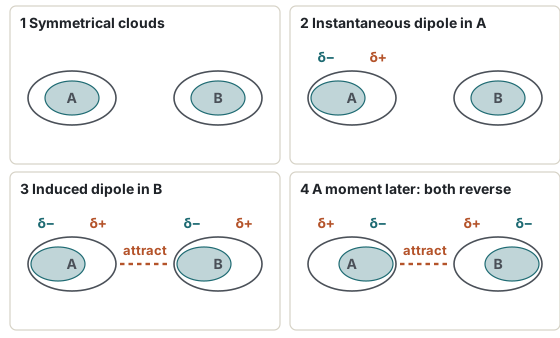
- On average the cloud is symmetrical and there are no charges.
- At one instant the electrons of molecule A are mostly at one end. That end is δ−, the other end is δ+. This is an instantaneous dipole.
- The δ+ end of A attracts the electrons of the neighbouring molecule B, and the δ− end repels them. B's cloud is pulled out of shape, so B has a dipole of its own: an induced dipole. The near end of B is the opposite charge to the near end of A, so the two molecules attract.
- The electrons keep moving, so A's dipole flips. B's induced dipole flips with it, a moment later. The ends that face each other stay opposite in charge, so the attraction is always there.
Each individual attraction is tiny and lasts a fraction of a second. But there are enormous numbers of them, and they act all the time, so together they hold the molecules together. Another name for London forces is instantaneous dipole–induced dipole forces. Mark schemes accept either name.
What makes London forces stronger 7.1(i)
The more electrons a molecule has, the larger its electron cloud. A large cloud is easier to distort, so the instantaneous dipoles are bigger, the induced dipoles are bigger, and the attraction is stronger. Stronger London forces mean more energy is needed to separate the molecules, so the boiling temperature is higher.
To compare London forces, count the electrons: add up the atomic numbers of all the atoms. A molecule of CH₄ has 6 + 4 × 1 = 10 electrons. The next page uses this to explain the trend in the alkanes.
Worked exampleExplain how London forces arise between Cl₂ molecules
- The electron cloud of a Cl₂ molecule moves, so for an instant one end has more electrons: an instantaneous dipole (δ− at one end, δ+ at the other).
- The δ+ end attracts the electrons of a neighbouring Cl₂ molecule, and the δ− end repels them. The neighbour gets an induced dipole, with the near end the opposite charge.
- The oppositely charged ends of the two molecules attract. These are London forces.
Check yourself
- Define London forces.
- Explain why a molecule with no permanent dipole, such as CH₄, still attracts its neighbours.
- At one instant the electrons of molecule A are mostly at its right-hand end. B is a neighbour on the right of A. Say which end of A is δ−, and which end of B becomes δ+. Why do A and B attract?
- Are these statements true or false? Correct any that are false. (a) London forces only exist between non-polar molecules. (b) London forces act between the atoms inside a molecule. (c) The dipoles in London forces are instantaneous and induced.
- Methane is a gas at room temperature but forms a liquid at −162 °C. Name the force that holds the molecules together in the liquid.
- Does liquid HCl have London forces? Explain.
Answers cover these until you have tried the questions
- Attractions between an instantaneous dipole in one molecule and an induced dipole in a neighbouring molecule.
- The electrons keep moving, so at an instant one end of a CH₄ molecule is δ− and the other δ+ (an instantaneous dipole). This induces a dipole in a neighbour, and the oppositely charged ends attract. The dipoles keep flipping together, so the attraction never goes away.
- The right-hand end of A is δ−. It repels the electrons of B, pushing them to B's far end. The near (left) end of B is therefore δ+. A's δ− end and B's δ+ end are oppositely charged, so they attract.
- (a) False: every molecule has London forces, polar or not. (b) False: they act between molecules, not between atoms inside a molecule. (c) True.
- London forces (instantaneous dipole–induced dipole). CH₄ has no permanent dipole, so there is no other force between its molecules.
- Yes. Every molecule has London forces. HCl also has permanent dipole–dipole interactions, on top of its London forces.