Topic 7 · page 9 of 14
Alcohols against alkanes
An alcohol boils much higher than an alkane with the same number of electrons. The electrons give similar London forces, and the O–H group adds hydrogen bonds, so the alcohol is less volatile.
Read first: Predicting hydrogen bonding, Alkane chains and branching
Same electrons, different forces 7.57.5(iii)
An alcohol contains an O–H group. The oxygen is bonded to a hydrogen atom, so alcohol molecules form hydrogen bonds with each other (page 6). An alkane has only C–H and C–C bonds, so it has London forces only.
To show the effect of the hydrogen bonds, you need to compare an alcohol with an alkane that has the same number of electrons. Then the London forces are about equal, and any large difference must come from the extra force.
| Alkane | Electrons | Boiling temperature / °C | Alcohol | Electrons | Boiling temperature / °C |
|---|---|---|---|---|---|
| ethane, C₂H₆ | 18 | −89 | methanol, CH₃OH | 18 | 65 |
| propane, C₃H₈ | 26 | −42 | ethanol, C₂H₅OH | 26 | 78 |
| butane, C₄H₁₀ | 34 | −1 | propan-1-ol, C₃H₇OH | 34 | 97 |
Check the electron counts: CH₃OH has 6 + 4 + 8 = 18; C₂H₅OH has 12 + 6 + 8 = 26; C₃H₇OH has 18 + 8 + 8 = 34. Each alcohol has the same number of electrons as the alkane beside it. The alcohol is the alkane with one CH₂ group swapped for an O atom, and CH₂ has 6 + 2 = 8 electrons, the same as O.
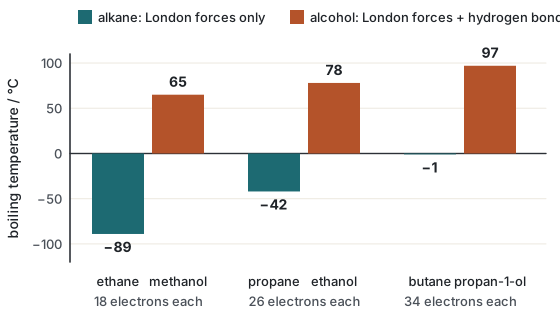
In each pair the alcohol boils far higher: by 154 °C for ethane and methanol, by 120 °C for propane and ethanol, and by 98 °C for butane and propan-1-ol. The London forces are similar, so the difference is the hydrogen bonds between the alcohol molecules. More energy is needed to separate them.
Another way to say the same thing is in terms of volatility. A liquid is volatile if it evaporates easily. A higher boiling temperature means lower volatility. Alcohols are less volatile than alkanes with a similar number of electrons.
Worked exampleExplain the boiling temperatures of ethanol and propane
Propane boils at −42 °C and ethanol at 78 °C.
- Count electrons: C₃H₈ has 3 × 6 + 8 = 26. C₂H₅OH has 2 × 6 + 6 + 8 = 26. They are equal, so their London forces are similar.
- Propane has only London forces between its molecules.
- Ethanol has an O–H bond, so its molecules form hydrogen bonds as well as London forces.
- Hydrogen bonds are stronger, so more energy is needed to separate ethanol molecules, and ethanol boils at the higher temperature.
Isomers with the same formula 7.5(iii)
Ethanol and methoxymethane, CH₃OCH₃, both have the formula C₂H₆O and 26 electrons. Even with the same atoms and the same electrons, they boil at different temperatures.
| Ethanol | Methoxymethane | |
|---|---|---|
| Structure | CH₃CH₂–O–H | CH₃–O–CH₃ |
| Hydrogen bonds? | yes (O–H) | no (no H on O) |
| Other forces | London | London and permanent dipole–dipole |
| Boiling temperature | 78 °C | −24 °C |
Methoxymethane is polar, so it has permanent dipole–dipole interactions, but these are weaker than hydrogen bonds. The difference is 78 − (−24) = 102 °C.
Check yourself
- Work out the number of electrons in a molecule of ethanol, C₂H₅OH, and in one of propane, C₃H₈.
- Explain why ethanol (78 °C) boils at a higher temperature than propane (−42 °C).
- Say what "less volatile" means, and which of methanol and ethane is less volatile.
- Explain why the comparison between an alcohol and an alkane is made with the same number of electrons.
- Ethanol (78 °C) and methoxymethane (−24 °C) have the same formula, C₂H₆O. Explain the difference.
- Propan-1-ol has 34 electrons and butane has 34 electrons. Work out the difference in their boiling temperatures, and say what causes it.
Answers cover these until you have tried the questions
- Ethanol: 2 × 6 + 6 × 1 + 8 = 26 electrons (C₂H₆O). Propane: 3 × 6 + 8 = 26 electrons.
- Both have 26 electrons, so their London forces are similar. Propane has only London forces. Ethanol has an O–H group, so it forms hydrogen bonds between molecules as well. Hydrogen bonds are stronger, so more energy is needed to separate ethanol molecules, and it boils at a higher temperature.
- "Less volatile" means it evaporates less easily, so it has a higher boiling temperature. Methanol (65 °C) is less volatile than ethane (−89 °C).
- With the same number of electrons, the London forces are about the same, so any large difference in boiling temperature must come from the extra force: the hydrogen bonds in the alcohol.
- Same number of electrons, so similar London forces. Ethanol has an O–H bond, so it has hydrogen bonds. In methoxymethane, no H is bonded to O, so it has only permanent dipole–dipole interactions and London forces, which are weaker than hydrogen bonds. More energy is needed to separate ethanol molecules.
- 97 − (−1) = 98 °C higher for propan-1-ol. The cause is the hydrogen bonds between propan-1-ol molecules (O–H group); butane has only London forces of similar size.