Topic 7 · page 3 of 14
Alkane chains and branching
Longer alkane chains have more electrons, stronger London forces and higher boiling temperatures. Branching keeps the electron count the same but reduces surface contact, so a branched isomer boils lower than the straight chain.
Read first: London forces
Longer chains boil higher 7.57.5(i)
The alkanes are non-polar, so the only force between their molecules is the London force. That makes them the cleanest test of the idea from the last page: more electrons, stronger London forces.
An alkane has 6n + (2n + 2) = 8n + 2 electrons. Each extra CH₂ adds 6 + 2 = 8.
| Alkane | Formula | Electrons | Boiling temperature / °C | State at 25 °C |
|---|---|---|---|---|
| methane | CH₄ | 10 | −162 | gas |
| ethane | C₂H₆ | 18 | −89 | gas |
| propane | C₃H₈ | 26 | −42 | gas |
| butane | C₄H₁₀ | 34 | −1 | gas |
| pentane | C₅H₁₂ | 42 | 36 | liquid |
| hexane | C₆H₁₄ | 50 | 69 | liquid |
| heptane | C₇H₁₆ | 58 | 98 | liquid |
| octane | C₈H₁₈ | 66 | 126 | liquid |
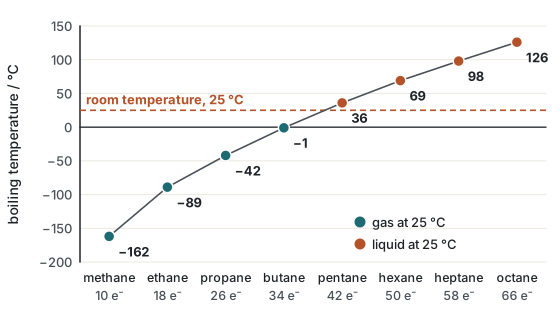
The explanation is a chain of five links. Write all of them.
- A longer chain has more electrons.
- The electron cloud is larger and easier to distort, so the instantaneous dipoles are larger.
- The London forces between molecules are stronger.
- More energy is needed to separate the molecules.
- So the boiling temperature is higher.
The rise gets smaller as the chain grows. From one alkane to the next it is 73, 47, 41, 37, 33, 29 and 28 °C. For the exam you only need the direction and the reason. Use the table to decide the state of an alkane at room temperature: methane to butane boil below 25 °C and are gases, and pentane and above boil higher and are liquids.
Worked exampleCount the electrons
How many electrons are in a molecule of hexane, C₆H₁₄?
- Carbon has 6 electrons per atom: 6 × 6 = 36.
- Hydrogen has 1 electron per atom: 14 × 1 = 14.
- Total = 36 + 14 = 50. The formula 8n + 2 gives 8 × 6 + 2 = 50, which agrees.
Branching lowers the boiling temperature 7.57.5(ii)
The formula C₅H₁₂ has three isomers. Compare them.
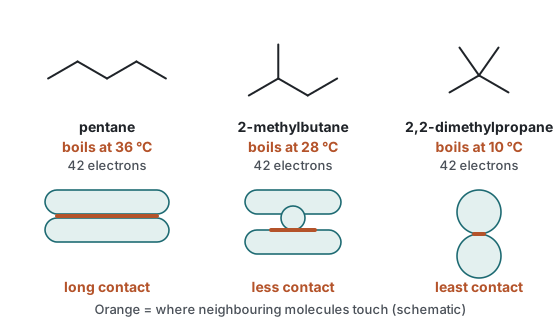
All three have the formula C₅H₁₂. They have the same number of electrons, 42 (5 × 6 + 12 = 42), and the same (72.0). So the number of electrons cannot be the reason they differ. What changes is the shape.
- A straight chain is long and can lie alongside its neighbours, so it touches them over a large surface. Many instantaneous dipole–induced dipole attractions form.
- A branched molecule is more compact and rounder. It touches its neighbours over a smaller surface, so fewer attractions form.
- Fewer attractions mean weaker London forces overall, so less energy is needed to separate the molecules and the boiling temperature is lower.
The more branches there are, the more compact the molecule becomes, so the boiling temperature falls further: 36 °C, 28 °C, 10 °C.
Check yourself
- Work out the number of electrons in a molecule of propane, C₃H₈, and of heptane, C₇H₁₆.
- Explain why heptane (98 °C) boils at a higher temperature than propane (−42 °C).
- Use the table to say which of butane and pentane is a liquid at 25 °C, and give a reason based on boiling temperatures.
- Explain why pentane (36 °C) boils at a higher temperature than 2,2-dimethylpropane (10 °C).
- An isomer of hexane has two methyl branches on a four-carbon chain. Predict whether it boils above or below hexane (69 °C), and explain.
- A student says: "2-methylbutane boils lower than pentane because it has fewer electrons." Give the mistake and the correct reason.
Answers cover these until you have tried the questions
- Propane: 3 × 6 + 8 = 26 electrons. Heptane: 7 × 6 + 16 = 58 electrons.
- Heptane has more electrons (58 against 26), so its London forces are stronger. More energy is needed to separate the molecules, so it boils at a higher temperature.
- Pentane is the liquid: it boils at 36 °C, which is above 25 °C. Butane boils at −1 °C, which is below 25 °C, so it is a gas at 25 °C.
- Both have 42 electrons. 2,2-Dimethylpropane is branched and compact, so it has less surface contact with its neighbours and weaker London forces. Less energy is needed to separate its molecules, so it boils at a lower temperature. Pentane is a straight chain with more surface contact.
- Below 69 °C. It has the same formula (C₆H₁₄) and the same 50 electrons as hexane, but the branched molecule is more compact, with less surface contact and weaker London forces.
- The two molecules are isomers (C₅H₁₂), so they have the same number of electrons (42). 2-Methylbutane boils lower because it is branched and more compact, with less surface contact and weaker London forces.