Topic 7 · page 8 of 14
Why ice floats
In ice, hydrogen bonds hold each water molecule in an open lattice with empty space inside it. When ice melts, some hydrogen bonds break, the lattice collapses and the molecules pack closer, so liquid water is denser than ice.
Read first: Why water melts and boils so high
An open lattice 7.37.3(ii)
Almost every substance is denser as a solid than as a liquid. Water is an exception: ice is less dense than liquid water, so it floats.
| Ice (at 0 °C) | Liquid water (at 0 °C) | |
|---|---|---|
| Density | 0.917 g cm⁻³ | 1.00 g cm⁻³ |
Density is mass divided by volume. The same number of molecules takes up more space as ice than as liquid water.
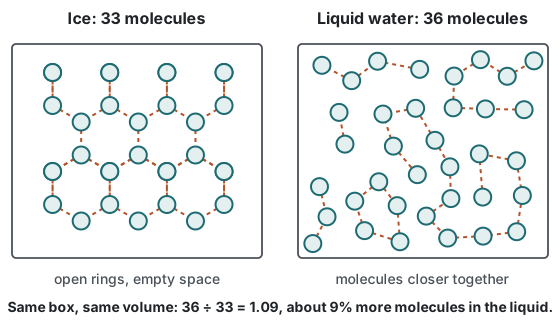
In ice, every water molecule forms four hydrogen bonds to four neighbours, using both of its δ+ H atoms and both of its lone pairs. The hydrogen bonds are directional: each O–H···O is a straight line, and the four bonds around one molecule point to the corners of a tetrahedron. Fixed angles and lengths build a regular, open hexagonal lattice. The rings of molecules enclose empty space, so the molecules are held relatively far apart.
When ice melts, some of the hydrogen bonds break. The rigid lattice collapses, and the molecules move closer together, into the spaces that were empty. Many hydrogen bonds still remain in the liquid, but they keep breaking and re-forming, so the structure is not rigid or open. The molecules are packed more tightly, so more molecules fit into the same volume, and the density is higher.
Worked exampleHow much does water expand when it freezes?
Find the volume of ice formed when 1.00 kg of water freezes at 0 °C, and the percentage increase in volume.
- Mass = 1.00 kg = 1000 g. Volume of water = mass ÷ density = 1000 ÷ 1.00 = 1000 cm³.
- Volume of ice = 1000 ÷ 0.917 = 1090.5 cm³ (about 1.09 dm³).
- Increase = 1090.5 − 1000 = 90.5 cm³.
- Percentage increase = 90.5 ÷ 1000 × 100 = 9.05 %, about 9 %.
The same figure in the other direction: the density ratio 1.00 ÷ 0.917 = 1.09 means liquid water holds about 9 % more molecules per unit volume (the 36 and 33 molecules in the figure).
This has two everyday effects. Water pipes burst in a hard frost because the ice takes up about 9 % more room. In a cold winter a pond freezes from the top down, because the ice floats and forms a layer on the surface, and the water underneath stays liquid.
Check yourself
- State the density of ice and the density of liquid water at 0 °C, and say which is greater.
- Explain, in terms of hydrogen bonds, why ice is less dense than liquid water.
- A student writes: "Ice floats because the molecules expand when they freeze." Correct the error.
- Calculate the volume of ice formed when 250 g of water freezes, and the percentage increase in volume.
- A block of ice of volume 100 cm³ melts. Calculate the volume of water formed.
- Explain why a pond freezes from the top down.
Answers cover these until you have tried the questions
- Ice 0.917 g cm⁻³; liquid water 1.00 g cm⁻³. Liquid water is denser.
- In ice, each molecule is held by four hydrogen bonds in a fixed open lattice with empty space inside the hexagonal rings, so the molecules are far apart. When ice melts, some hydrogen bonds break and the lattice collapses, so the molecules move closer together and more molecules fit into the same volume. Liquid water is denser.
- The molecules do not expand. They are the same size in ice and water. In ice they are held further apart by hydrogen bonds in an open lattice.
- Water: 250 ÷ 1.00 = 250 cm³. Ice: 250 ÷ 0.917 = 272.6 cm³ (273 cm³). Increase = 272.6 − 250 = 22.6 cm³, or 22.6 ÷ 250 × 100 = 9.05 % (about 9 %).
- Mass of ice = 100 × 0.917 = 91.7 g. Volume of water = 91.7 ÷ 1.00 = 91.7 cm³. (The volume falls by 8.3 cm³, or 8.3 %.)
- Ice is less dense than water, so as the surface cools to 0 °C and freezes, the ice floats and forms a layer on top. The water below stays liquid.