Topic 9 · page 15 of 15
Evaluating data on yield and rate
How to read a table or graph of yield and rate against temperature and pressure, and turn it into a recommended set of conditions. The method is describe, explain, spot the conflict, recommend.
Read first: Yield, rate and the industrial compromise
Reading yield and rate graphs 9.11
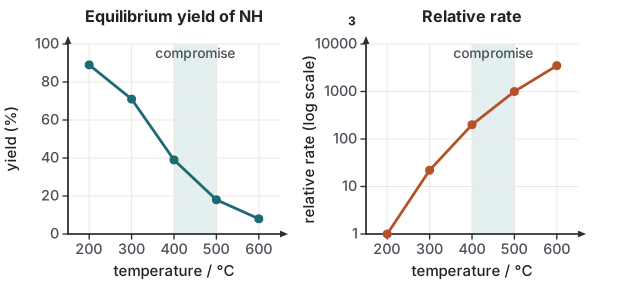
"Evaluate data" means more than describing it. You are asked to use numbers to decide something, and to give reasons. The figure below shows the Haber data from page 14 as two graphs against the same temperature axis.
Points to watch when you read graphs like these:
- Read the axes first. The right-hand graph is on a log scale: equal steps up are equal factors, not equal differences. The rate rises by a factor of about 3500 in total, even though the line looks fairly gentle.
- Quote values, with units: "falls from 89% at 200 °C to 8% at 600 °C" is better than "falls a lot".
- Use a ratio where it helps: 89 ÷ 8 = 11 times lower yield, 3500 times higher rate.
A method for the exam 9.11
- Describe each trend with numbers: how yield and rate change as the condition changes.
- Explain each trend with chemistry: yield with Le Chatelier (sign of ΔH, moles of gas), rate with collisions and .
- Spot the conflict: the condition that helps the yield hurts the rate, or costs too much.
- Recommend conditions in the middle, and say what makes them workable: a catalyst to raise the rate, recycling to rescue the yield, and the cost and safety of the plant.
- Add a limit if you can: the data show only equilibrium yield, so they say nothing about the cost, the catalyst's life or the rate of other reactions.
Worked exampleMethanol from carbon monoxide and hydrogen
Illustrative data for the equilibrium yield of CH₃OH (the percentage of CO converted) and the relative rate (rate at 200 °C = 1), at 100 atm:
| Temperature (°C) | Yield (%) | Relative rate |
|---|---|---|
| 200 | 62 | 1 |
| 250 | 41 | 8 |
| 300 | 23 | 45 |
| 350 | 11 | 190 |
And the yield at 250 °C at different pressures:
| Pressure (atm) | Yield (%) |
|---|---|
| 50 | 21 |
| 100 | 41 |
| 200 | 63 |
| 400 | 80 |
Recommend conditions.
- Describe temperature. From 200 to 350 °C the yield falls from 62% to 11%, a factor of 62 ÷ 11 = 5.6, and the rate rises by a factor of 190.
- Explain. The forward reaction is exothermic (ΔH = −91), so a higher temperature shifts the position to the left and the yield falls. The rate rises because more molecules have energy of at least .
- Describe pressure. From 50 to 400 atm the yield rises from 21% to 80%. The gain per atmosphere falls: 50 to 100 atm adds 41 − 21 = 20 percentage points for a rise of 50 atm, but 200 to 400 atm adds only 80 − 63 = 17 percentage points for a rise of 200 atm.
- Explain. There are 3 mol of gas on the left and 1 mol on the right, so a higher pressure shifts the position to the right. Higher pressure also increases the rate.
- Conflict. Low temperature gives the best yield but the reaction is very slow; high pressure helps both yield and rate but needs expensive, strong equipment.
- Recommend. A temperature of about 250–300 °C (a yield of 23–41% with a rate 8–45 times that at 200 °C), a pressure of 100–200 atm, a catalyst to speed up the reaction, and recycling of unreacted CO and H₂. Going above 200 atm costs more than the extra yield is worth.
Check yourself
Use the methanol data from the worked example.
- Calculate the factor by which the yield falls and the factor by which the rate rises from 250 °C to 350 °C.
- Explain both changes in question 1.
- Calculate the increase in yield, in percentage points, from 100 to 200 atm and from 200 to 400 atm at 250 °C. What does this suggest about using a pressure above 200 atm?
- A reactor at 250 °C and 100 atm converts CO with the yield in the table. Calculate the mass of CH₃OH formed from 500 mol of CO, and the mass at 300 °C. ( of CH₃OH = 32.0)
- Recommend conditions, with reasons, for making methanol.
- A student says that a catalyst can be used to raise the yield at 350 °C from 11% to 62%. Evaluate this claim.
Answers cover these until you have tried the questions
- Yield: 41 ÷ 11 = 3.7 times lower. Rate: 190 ÷ 8 = 24 times higher.
- The reaction is exothermic, so raising the temperature shifts the position to the left (the endothermic direction), and the yield falls. The rate rises because a greater proportion of molecules have energy of at least , so more collisions are successful.
- 100 to 200 atm: 63 − 41 = 22 percentage points. 200 to 400 atm: 80 − 63 = 17 percentage points. The extra gain is smaller although the pressure rise is bigger, so above 200 atm the extra cost of compression and strong equipment is unlikely to be repaid.
- At 250 °C: 500 × 0.41 = 205 mol CH₃OH; 205 × 32.0 = 6560 g = 6.56 kg. At 300 °C: 500 × 0.23 = 115 mol; 115 × 32.0 = 3680 g = 3.68 kg.
- About 250–300 °C, 100–200 atm, with a catalyst and recycling of unreacted CO and H₂. Reasons: the temperature balances a reasonable yield (exothermic reaction) against a rate that is high enough; the pressure shifts the position to the side with fewer moles of gas (3 to 1) and speeds up the reaction, but a higher pressure costs more than the extra yield is worth; the catalyst raises the rate without a high temperature; recycling uses the reactants left unreacted after each pass.
- Incorrect. A catalyst only increases the rate of the forward and backward reactions equally and so does not change the equilibrium position or yield. The yield at 350 °C would still be 11%. To raise the yield, lower the temperature or raise the pressure, which changes the position of equilibrium.