Topic 9 · page 11 of 15
Reversible reactions and dynamic equilibrium
Many reactions go both ways. In a closed system a reversible reaction settles into dynamic equilibrium, where the forward and backward rates are equal and the concentrations stay constant, though not equal.
So far a reaction went one way, from reactants to products, until something ran out. Many reactions do not behave like that. This page and the rest of the topic deal with reactions that can go in both directions, and ask how far they go.
Reversible reactions 9.9
In a reversible reaction the products can react to form the reactants again. The equation uses the sign ⇌ to show it.
Two examples you can see with your own eyes:
Hydrated copper(II) sulfate. Blue crystals turn white when heated, because the water of crystallisation is driven off. Adding water to the white solid turns it blue again, and the mixture warms up.
Dinitrogen tetroxide. A sealed tube holds colourless N₂O₄ and brown NO₂. Heating the tube turns the gas darker brown, and cooling it makes it paler.
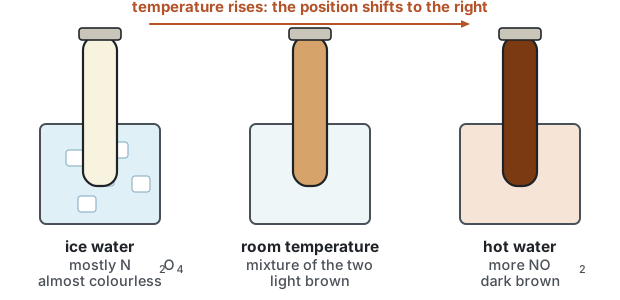
"Readily reversible" means the reaction changes direction easily when you change the conditions, such as the temperature, with no need for a different reagent.
Dynamic equilibrium 9.99.9(i)9.9(ii)
Put some N₂O₄ in a sealed tube. At first only the forward reaction can happen. As NO₂ appears, the backward reaction starts, and speeds up as more NO₂ builds up. Meanwhile the forward reaction slows, because N₂O₄ is being used up. At some point the two rates become equal. From then on, N₂O₄ is being turned into NO₂ as fast as NO₂ is turned back into N₂O₄, so the amounts stop changing.
A closed system is one where nothing enters or leaves, such as a sealed flask. Energy can still be exchanged with the surroundings.
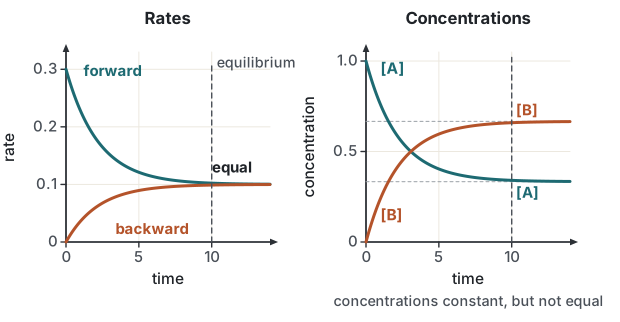
Read the two graphs together:
- Rates (left). The forward rate starts highest, because [A] is highest, and falls as A is used up. The backward rate starts at zero and rises as B builds up. When the lines meet, the two rates are equal (condition i) and they stay equal.
- Concentrations (right). [A] falls and [B] rises until the same moment. After that, both stay flat (condition ii).
The word dynamic matters. At equilibrium nothing looks as if it is changing, but both reactions are still going on, at the same rate. It is a balance of two processes, not a reaction that has stopped.
Constant does not mean equal 9.9(ii)
The concentrations at equilibrium are constant, but they are not necessarily equal. In the graphs, [B] at equilibrium is twice [A]. The position of equilibrium describes the proportions of reactants and products in the equilibrium mixture. If the mixture is mostly products, the position lies to the right (towards the products). If it is mostly reactants, it lies to the left.
Equilibrium can also be reached from either side. Start with pure N₂O₄ or pure NO₂ in a sealed tube at the same temperature and you end with the same mixture.
Check yourself
- State what is meant by dynamic equilibrium.
- Explain why equilibrium is described as "dynamic".
- A sealed flask holds A ⇌ B at equilibrium. State what is true of (a) the rates of the two reactions and (b) the concentrations of A and B.
- Starting with pure A, explain why the forward rate falls and the backward rate rises during the approach to equilibrium.
- Calcium carbonate is heated in an open tube: CaCO₃(s) ⇌ CaO(s) + CO₂(g). Explain why this does not reach equilibrium.
- A student says that at equilibrium the concentrations of reactants and products are equal. Correct this, with a reason.
Answers cover these until you have tried the questions
- In a closed system, the forward and backward reactions occur at the same rate, and the concentrations of reactants and products stay constant.
- Both the forward and the backward reactions are still taking place, at equal rates. Nothing appears to change, but molecules are continually reacting in both directions.
- (a) The rate of the forward reaction equals the rate of the backward reaction. (b) The concentrations of A and B are constant (not changing with time). They are not necessarily equal.
- [A] falls as A is used up, so the forward rate falls. B is made, so [B] rises, and the backward rate rises from zero. The rates become equal at equilibrium.
- The system is open: CO₂ escapes into the air, so the products cannot react to re-form the reactant. The forward reaction goes to completion instead of reaching equilibrium.
- The concentrations are constant, but not necessarily equal. Their values depend on the position of equilibrium. For example, in A ⇌ B with a mixture that is two-thirds B, [B] is twice [A] and still constant.