Topic 9 · page 9 of 15
Catalysts and the Maxwell–Boltzmann curve
A catalyst does not change the temperature, so the curve stays exactly the same. It moves the activation energy to the left, so more molecules lie beyond it. Temperature moves the curve; a catalyst moves the line.
Read first: Temperature and the curve, Catalysts and reaction profiles
The catalyst moves the activation energy, not the curve 9.8
The Maxwell–Boltzmann curve describes the energies of the molecules at one temperature. A catalyst does not heat anything, so the curve is unchanged. What the catalyst changes is the activation energy: the alternative route has a lower barrier (page 8), so the line moves to the left.
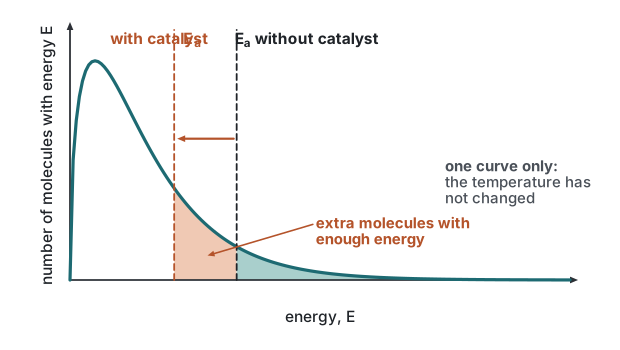
The area to the right of the new is bigger than before. More molecules have energy of at least the (lower) activation energy, so a greater proportion of collisions are successful and the rate is higher. The extra area is the strip between the two lines.
Worked exampleExplaining a catalyst with the distribution
Explain, using the Maxwell–Boltzmann distribution, how a catalyst increases the rate at constant temperature.
- The catalyst provides an alternative route with a lower activation energy.
- The distribution of molecular energies is unchanged (same temperature, same curve).
- The line moves to the left, so more molecules have energy greater than or equal to .
- A greater proportion of collisions are successful, so the rate increases.
Temperature against catalyst 9.8
The two changes have the same result, more molecules above the line, reached in opposite ways.
| Raise the temperature | Add a catalyst | |
|---|---|---|
| The curve | changes: flatter, peak to the right | stays the same |
| stays where it is | moves to the left | |
| More molecules with because | the curve moves | the line moves |
Check yourself
- Explain, using the Maxwell–Boltzmann distribution, why a catalyst increases the rate at constant temperature.
- For each of raising the temperature and adding a catalyst, state whether the curve changes and whether changes.
- A student sketches two curves for a reaction, one without and one with a catalyst, at the same temperature. Explain why this is wrong.
- State one way in which the effects of a catalyst and a temperature rise are alike, and one way in which they differ.
- Does adding a catalyst change the amount of product eventually made? Explain.
Answers cover these until you have tried the questions
- The catalyst provides an alternative route with a lower activation energy. The distribution is unchanged, but the line moves to the left, so more molecules have energy greater than or equal to . A greater proportion of collisions are successful, so the rate increases.
- Raising the temperature: the curve changes (flatter, peak to the right) and does not change. Adding a catalyst: the curve does not change and moves to a lower value.
- The temperature is the same, so the distribution of energies is the same curve. A catalyst changes , not the curve. The sketch should show one curve and two lines.
- Alike: both increase the proportion of molecules with energy of at least , so more collisions are successful. Different: a temperature rise changes the curve and keeps fixed, while a catalyst keeps the curve and lowers .
- No. The amount of product depends on the amount of limiting reactant (and, for a reversible reaction, on the position of equilibrium). A catalyst only changes how fast the reaction proceeds.