Topic 6 · page 11 of 15
Core Practical 2: method
Magnesium cannot be burned in a calorimeter to give a clean enthalpy change of formation. Instead, measure the heat of magnesium with acid and of magnesium oxide with acid, then use Hess's Law.
Read first: Graphs and cooling-curve corrections, Hess cycles from formation and combustion data
The idea and the two reactions 6.7
The aim is to determine the enthalpy change of formation of magnesium oxide:
You cannot measure it directly. Burning magnesium in a calorimeter is violent, the heat cannot be collected in water, and the oxide formed is not pure. But both magnesium and magnesium oxide react with hydrochloric acid in a polystyrene cup, and each gives a temperature change you can measure.
Both reactions give the same magnesium chloride solution. The enthalpy change of formation of water, (H₂O(l)) = −285.8 kJ mol⁻¹, is taken from a data book. The three values then link up in a cycle, which the next page builds.
The method 6.7
PracticalEnthalpy change of magnesium and of magnesium oxide with acid
Do the experiment twice, once with magnesium and once with magnesium oxide. This is a typical method; follow your own centre's instructions if they differ.
- Weigh the solid accurately in a weighing boat or on a balance: about 0.120 g of magnesium (or about 0.400 g of magnesium oxide). Record the mass to 3 decimal places.
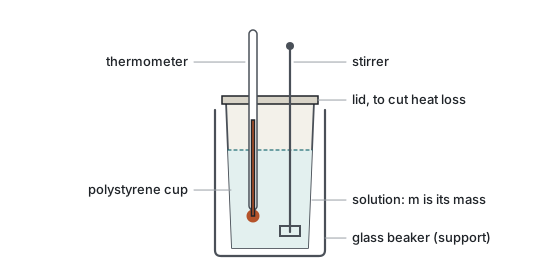
- Place a polystyrene cup in a beaker. Measure 50.0 cm³ of 1.0 mol dm⁻³ hydrochloric acid into the cup. Put on the lid with a thermometer and a stirrer.
- Record the temperature of the acid every minute for 3 minutes (0, 1, 2 and 3 min).
- At 4 min, add the solid. Do not record at 4 min. Replace the lid quickly and stir.
- Record the temperature every minute from 5 min to 12 min.
- Plot temperature against time. Use the cooling line, extended back to 4 min, to find ΔT (see the page on graphs).
- Repeat each reaction and take the mean ΔH.
| Step | Why |
|---|---|
| Acid in excess | All the solid reacts, so the moles come from the mass of the solid |
| Same volume of acid each time | The mass of solution in q = mcΔT is the same, 50.0 g |
| Lid, polystyrene, stirring | Cut heat loss, and make the temperature even |
| Readings before adding the solid | A steady starting temperature, and a baseline for the graph |
| No reading at 4 min | The solid is being added and stirred |
| Readings long enough to see the cooling | The cooling line is needed for the correction |
Quantities and observations 6.7
The masses are chosen so that the acid is in excess but the temperature rise is large enough for a small percentage uncertainty.
| Magnesium | Magnesium oxide | |
|---|---|---|
| Mass of solid | 0.120 g | 0.400 g |
| Moles of solid | 0.120 ÷ 24.3 = 0.00494 mol | 0.400 ÷ 40.3 = 0.00993 mol |
| Moles of HCl needed (2 per mole) | 0.00988 mol | 0.0199 mol |
| Moles of HCl present | 0.0500 mol | 0.0500 mol |
| Observation | fizzing, solid disappears, temperature rises | white solid dissolves slowly, temperature rises |
| Explanation | hydrogen forms; exothermic | neutralisation of a base by an acid; exothermic |
Both reactions are exothermic, so each ΔH is negative. Magnesium reacts faster than magnesium oxide, which dissolves slowly, so more heat is lost during the MgO experiment. The cooling-curve correction matters for both.
Safety. Wear eye protection. The 1.0 mol dm⁻³ acid is an irritant, the fizzing can spit, and hydrogen is flammable, so keep naked flames away from the magnesium reaction.
Check yourself
- Explain why the enthalpy change of formation of magnesium oxide is determined by this indirect method.
- Why is the hydrochloric acid in excess?
- Calculate the moles of HCl in 50.0 cm³ of 1.0 mol dm⁻³ acid, and show that 0.120 g of magnesium is the limiting reagent.
- Why is the temperature recorded for three minutes before the solid is added?
- State which quantity must be known accurately to find the moles, and explain why the concentration of the acid need not be exact.
- Write the equation and state two observations for the reaction of magnesium with hydrochloric acid.
Answers cover these until you have tried the questions
- Burning magnesium is violent and the heat cannot be collected and measured in a cup or calorimeter, and the oxide formed is not pure. The reactions with acid are easy to measure, so Hess's Law links them to the formation of MgO.
- So that all of the solid reacts. The amount of solid that reacts is then known from its mass, and the moles used to find ΔH are exact.
- n(HCl) = 0.0500 dm³ × 1.0 mol dm⁻³ = 0.050 mol. n(Mg) = 0.120 ÷ 24.3 = 0.00494 mol, which needs 2 × 0.00494 = 0.00988 mol of HCl. That is much less than 0.050 mol, so HCl is in excess and magnesium is limiting.
- To establish a steady starting temperature and a baseline line for the graph. The initial temperature is needed to find ΔT, and the steady readings show it is not drifting.
- The mass of the solid must be weighed accurately, because it gives the moles. The acid is in excess, so the amount that reacts is set by the solid and not by the acid. The concentration of the acid therefore need only be approximately right. (The volume of acid still matters, because it sets the mass of solution in q = mcΔT, so measure it carefully and use the same volume each time.)
- . Observations: fizzing (or bubbles) and the magnesium disappears (dissolves); the temperature of the mixture rises.