Topic 6 · page 9 of 15
Hess's Law and enthalpy cycles
The enthalpy change of a reaction does not depend on the route. Draw a cycle with the route you want on one side and a route you have data for on the other, then add and subtract along the arrows.
Read first: Enthalpy changes of combustion, neutralisation and atomisation
Hess's Law 6.6
Many reactions cannot be measured directly. Carbon never burns to give only carbon monoxide, so you cannot weigh the heat of that reaction in a calorimeter. Hess's Law lets you find it from reactions you can measure.
Climbing a hill is the picture: the height you gain from the foot to the top does not depend on the path you take. If two routes between the same reactants and products gave different values of ΔH, you could go round one route and back by the other and create or destroy energy.
Worked exampleA reaction that cannot be measured directly
Find of carbon monoxide, , from these combustion values: (C) = −393.5 kJ mol⁻¹ and (CO) = −283.0 kJ mol⁻¹.
- Both start from carbon and oxygen and end in the same place, CO₂(g). Route 1: C to CO to CO₂. Route 2: C to CO₂ directly.
- Route 2 is the combustion of carbon: −393.5.
- Route 1 is ΔH(C to CO) followed by the combustion of CO: ΔH(C to CO) + (−283.0).
- The routes are equal: ΔH(C to CO) − 283.0 = −393.5.
- ΔH(C to CO) = −393.5 + 283.0 = −110.5 kJ mol⁻¹.
Constructing an enthalpy cycle 6.66.6(i)
A cycle is a closed shape of arrows. The reaction you want goes along one side. The other sides are reactions with known ΔH, joined through a common substance.
MethodBuilding a cycle
- Write the equation you want as the top arrow, from reactants to products, and label it ΔH = ?.
- Find a link that both sides can reach. With formation data the link is the elements. With combustion data the link is the combustion products (CO₂ and H₂O).
- Draw an arrow from the reactants to the link, and another from the products to the link. For formation data these arrows point up from the elements. For combustion data they point down to the products of burning.
- Label every arrow with its enthalpy change. If a substance appears with a coefficient in the equation, multiply its value by that number.
- Write the equation for ΔH by going from the reactants to the products by the indirect route: with an arrow add, against an arrow subtract.
The next page builds two cycles from data. Here is the rule for following arrows, on its own:
Worked exampleReading the arrows
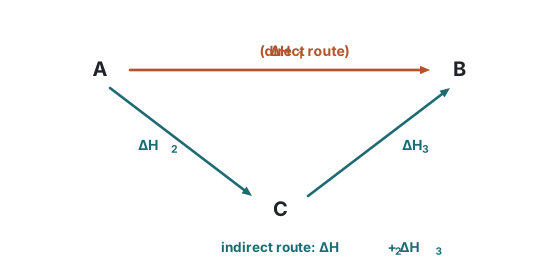
In a cycle, ΔH₁ is the top arrow (A to B). ΔH₂ points down from A to C. ΔH₃ points up from C to B. Find ΔH₁.
- A to C goes with ΔH₂: add ΔH₂.
- C to B goes with ΔH₃: add ΔH₃.
- ΔH₁ = ΔH₂ + ΔH₃.
If ΔH₃ had pointed the other way, from B to C, the route C to B would go against it, so ΔH₁ = ΔH₂ − ΔH₃.
Check yourself
- State Hess's Law.
- Substance P changes to R by two routes. Route 1: P to Q, ΔH = +50 kJ mol⁻¹, then Q to R, ΔH = −120 kJ mol⁻¹. Route 2: P to S, ΔH = −30 kJ mol⁻¹, then S to R, ΔH unknown. Calculate the unknown ΔH.
- For A to B, ΔH = −75 kJ mol⁻¹. State ΔH for B to A.
- of graphite is −393.5 and of hydrogen gas is −285.8 kJ mol⁻¹. Explain, with a labelled cycle in words, why combustion data can be used to find the enthalpy change of formation of an organic compound.
- A cycle has arrows from X down to Z (ΔH = −200) and from Y down to Z (ΔH = −350). Find ΔH for X to Y, and say whether the route goes with or against each arrow.
Answers cover these until you have tried the questions
- The enthalpy change for a reaction is independent of the route taken, provided the initial and final conditions are the same.
- Route 1 total = +50 + (−120) = −70 kJ mol⁻¹. Route 2 must be equal: −30 + ΔH = −70, so ΔH = −40 kJ mol⁻¹.
- Reversing the direction changes the sign: +75 kJ mol⁻¹.
- Burning carbon, burning hydrogen and burning the compound all give the same products, CO₂ and H₂O. The elements and the compound are joined to those products by arrows of known ΔcH, so the unknown step from the elements to the compound can be found as the difference of the routes.
- X to Y goes X to Z (with the first arrow) then Z to Y (against the second arrow): ΔH = −200 − (−350) = +150 kJ mol⁻¹.