Enthalpy changes of combustion, neutralisation and atomisation
Combustion counts per mole of fuel burnt, neutralisation per mole of water formed, atomisation per mole of gaseous atoms made. Know each definition and its equation, with state symbols.
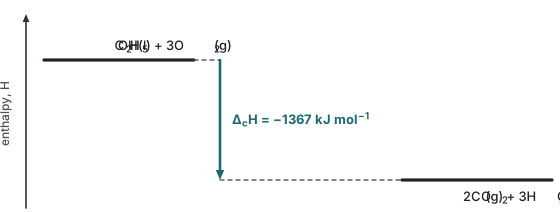
The equation has one mole of the fuel on the left and excess oxygen. For a compound of carbon, hydrogen and oxygen, the products are carbon dioxide gas and liquid water. Fractions of O₂ are fine.
Combustion is always exothermic, so the arrow always points down.
Combustion is always exothermic, so ΔcH⊖ is always negative.
Worked exampleA combustion equation with fractions
Write the equation for the standard enthalpy change of combustion of propan-1-ol, C₃H₇OH(l).
One mole of fuel on the left: C₃H₇OH(l) + O₂(g).
Products: 3 carbons give 3CO₂(g); 8 hydrogens give 4H₂O(l).
Oxygen needed on the right: 6 + 4 = 10 atoms. One is already in the alcohol, so 9 atoms come from O₂, which is 4½ O₂.
CX3HX7OH(l)+29OX2(g)3COX2(g)+4HX2O(l)
Some equations carry two names. C(s)+OX2(g)COX2(g) is both the formation of CO₂ and the combustion of carbon, so ΔfH⊖(CO2)=ΔcH⊖(C)=−393.5kJ mol−1. In the same way ΔcH⊖(H2)=ΔfH⊖(H2O(l))=−285.8kJ mol−1.
Enthalpy change of neutralisation 6.46.4(iv)
For a strong acid with a strong alkali the reaction is the same ionic equation whatever the pair:
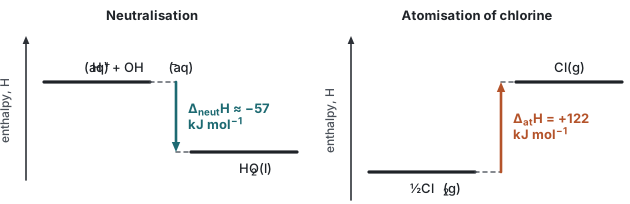
HX+(aq)+OHX−(aq)HX2O(l)ΔneutH⊖≈−57kJ mol−1
Neutralisation (exothermic, down) and atomisation (endothermic, up), both per mole of the product.
The count is per mole of water, not per mole of acid. Sulfuric acid is dibasic, so HX2SOX4+2NaOHNaX2SOX4+2HX2O makes two moles of water and releases about 2 × 57 = 114 kJ per mole of H₂SO₄. Neutralisation is always exothermic, so the sign is always negative.
Enthalpy change of atomisation 6.46.4(v)
Na(s)Na(g)ΔatH⊖=+107kJ mol−1
21ClX2(g)Cl(g)ΔatH⊖=+122kJ mol−1
The product is atoms, so chlorine, a gas of Cl₂ molecules, needs ½Cl₂. Particles must be pulled apart, which takes energy, so atomisation is always endothermic and ΔatH⊖ is always positive.
The five at a glance
Enthalpy change
Per one mole of
The equation features
Sign
reaction, ΔrH⊖
the reaction as written
any balanced equation
+ or −
formation, ΔfH⊖
compound formed
elements in standard states on the left
+ or −
combustion, ΔcH⊖
substance burned
O₂ in; CO₂(g) and H₂O(l) out
always −
neutralisation, ΔneutH⊖
water formed
H⁺(aq) + OH⁻(aq) → H₂O(l)
always −
atomisation, ΔatH⊖
gaseous atoms formed
element → gaseous atoms
always +
Check yourself
Write the equation for the standard enthalpy change of combustion of butane, C₄H₁₀(g).
Explain why the water in a combustion equation is written as H₂O(l) and not H₂O(g).
ΔcH⊖ of methane is −890 kJ mol⁻¹. How much heat is released when 8.00 g of methane burns completely? (Mr = 16.0)
Sulfuric acid reacts with sodium hydroxide: HX2SOX4(aq)+2NaOH(aq)NaX2SOX4(aq)+2HX2O(l). Estimate the enthalpy change for this equation as written, and explain why it is not −57 kJ mol⁻¹.
Write the equation for the standard enthalpy change of atomisation of (a) bromine, Br₂(l); (b) carbon, C(s). State the sign of each.
State two different names for the enthalpy change of HX2(g)+21OX2(g)HX2O(l), and give its value.
Answers cover these until you have tried the questions
The definition uses standard states, and water is a liquid at 298 K and 100 kPa. Water vapour would give a less negative value, because condensing to a liquid gives out extra heat.