Topic 6 · page 3 of 15
Enthalpy changes of reaction and formation
Each named enthalpy change is one exact equation with its own definition. Reaction is the general case; formation builds one mole of a compound from its elements in their standard states.
Read first: Enthalpy level diagrams
Why there are named enthalpy changes 6.4
"The enthalpy change of burning ethanol" is not one number until you say how much ethanol, at what pressure and temperature, and what the products are. The named standard enthalpy changes remove that doubt. Each name fixes one amount of one thing and the conditions, so the value can be looked up in a data book and used in later calculations.
There are five to learn: reaction, formation, combustion, neutralisation and atomisation. This page covers the first two; the next page covers the other three.
For every one you must be able to give the definition and write the equation with state symbols. Both need the idea of a standard state.
So the standard state of oxygen is O₂(g), of bromine is Br₂(l), of sodium is Na(s) and of carbon is graphite, C(s). Write these in equations as the elements appear at 298 K.
Enthalpy change of reaction 6.46.4(i)
This is the general definition. The other four are special cases with fixed reactants or products. "Per mole" here means per mole of reaction as the equation is written.
Both are correct. The second equation is half the first, so its enthalpy change is half as large. The size of ΔH only has meaning next to the equation it belongs to, so always write the equation with it.
Worked exampleFrom an equation to a different amount
The equation has . How much heat is released when 1.00 mol of H₂(g) burns?
- The equation uses 2 mol of H₂ for −571.6 kJ.
- For 1 mol of H₂, divide by 2: −571.6 ÷ 2 = −285.8.
- About 285.8 kJ of heat is released per mole of H₂ burnt.
Enthalpy change of formation 6.46.4(ii)
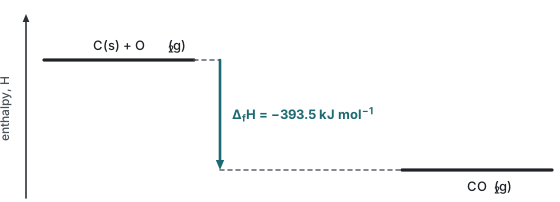
The compound goes on the right-hand side with a coefficient of 1. The left-hand side holds only elements, each in its standard state.
MethodWriting a formation equation
- Write one mole of the compound on the right, with its state symbol.
- Write each element on the left, in its standard state: gases as molecules (O₂, H₂, N₂, Cl₂), carbon as C(s), bromine as Br₂(l).
- Balance the atoms. Fractions are allowed on the elements so that the compound stays at exactly one mole.
Worked exampleFormation equations
Write the equation for the standard enthalpy change of formation of (a) ethanol, C₂H₅OH(l); (b) sodium chloride, NaCl(s).
(a) Two carbons, six hydrogens and one oxygen are needed, so .
(b) . Chlorine is a gas of Cl₂ molecules, so one chlorine atom needs ½Cl₂.
Three points about come up repeatedly.
- The reactants are elements, not atoms (no O(g) or H(g)) and not other compounds.
- The enthalpy change of formation of an element in its standard state is zero. Nothing is formed, so nothing changes. This is why elements drop out of the calculations on later pages.
- can be positive or negative. Many compounds are formed with heat given out; some, such as NO(g), take heat in. Half the +181 kJ mol⁻¹ from the previous page gives of about +90 kJ mol⁻¹.
Check yourself
- Define the standard enthalpy change of reaction.
- Write the equation, with state symbols, for the standard enthalpy change of formation of (a) methane, CH₄(g); (b) calcium carbonate, CaCO₃(s); (c) methanol, CH₃OH(l).
- Explain why the equation for the formation of hydrogen chloride is and not .
- has . State of ammonia, with the equation it refers to.
- State the value of of and of , and explain why.
- The equation has . State of MgO(s) and explain why the equation as written is not the formation equation.
Answers cover these until you have tried the questions
- The enthalpy change when the molar quantities of reactants shown in the equation react to give products, under standard conditions.
- (a) (b) (c) . Check (c): 1 C, 4 H and 1 O on each side.
- A formation equation starts from the elements in their standard states. Hydrogen and chlorine are diatomic gases, so one mole of HCl needs half a mole of each. H(g) and Cl(g) are atoms, not elements in their standard states.
- The equation makes two moles of NH₃, so is half of −92: −46 kJ mol⁻¹ for .
- Both are zero. They are elements in their standard states, so no change is needed to form them from themselves.
- The equation makes two moles of MgO, so = −1204 ÷ 2 = −602 kJ mol⁻¹, for . The definition needs one mole of compound.