Topic 1
Topic 1 on a page
Everything from this topic in one place, for the last read before an exam. If anything here is unfamiliar, follow the link back to the full page.
Constants and conversions
| Quantity | Value |
|---|---|
| Avogadro constant, L | 6.02 × 10²³ mol⁻¹ |
| molar volume at RTP | 24.0 dm³ mol⁻¹ = 24 000 cm³ mol⁻¹ |
| gas constant, R | 8.31 J mol⁻¹ K⁻¹ |
| temperature | K = °C + 273 |
| pressure | Pa = kPa × 10³ |
| volume | dm³ = cm³ ÷ 1000; m³ = dm³ ÷ 1000 = cm³ × 10⁻⁶ |
| ppm and % | ppm = % × 10⁴ |
The equations
| To find | Use | Page |
|---|---|---|
| amount from mass | n = m ÷ M | Relative mass and the mole |
| number of particles | N = n × L | Relative mass and the mole |
| amount in solution | n = c × V (V in dm³) | Solutions and ppm |
| mass concentration | g dm⁻³ = mol dm⁻³ × M | Solutions and ppm |
| parts per million | part ÷ whole × 10⁶ | Solutions and ppm |
| amount of gas at RTP | n = V ÷ 24.0 (V in dm³) | Gas volumes |
| amount of gas, any conditions | pV = nRT (Pa, m³, K) | Gas volumes |
| molar mass of a vapour | M = mRT ÷ pV | Gas volumes |
| percentage yield | actual ÷ theoretical × 100 | Yield and atom economy |
| atom economy | M(desired) ÷ ΣM(all products) × 100 | Yield and atom economy |
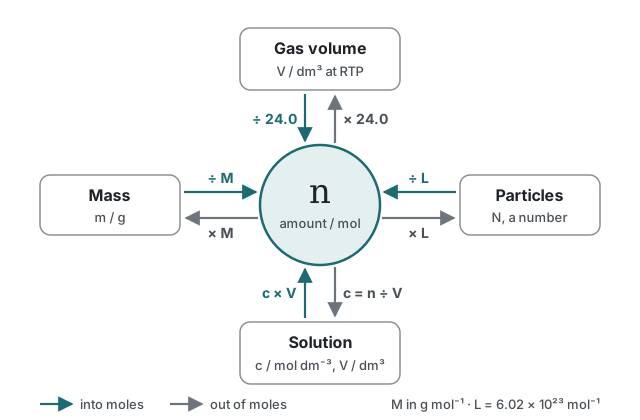
Definitions to learn word for word
- Relative atomic mass: the weighted mean mass of an atom of an element, relative to one twelfth of the mass of an atom of carbon-12.
- Mole: the amount of substance containing 6.02 × 10²³ particles, the same number as atoms in exactly 12 g of carbon-12.
- Molar mass: the mass per mole of a substance, in g mol⁻¹.
- Empirical formula: the simplest whole-number ratio of atoms of each element in a compound.
- Molecular formula: the actual number of atoms of each element in one molecule.
- Atom economy: the percentage, by mass, of the products that is the desired product.
Methods
- Reacting masses: mass → moles → ratio → moles → mass.
- Limiting reactant: convert both to moles, allow for the ratio, and the one that runs out first decides the product.
- Empirical formula: mass of each element → ÷ → ÷ smallest → multiply to whole numbers.
- Molecular formula: ÷ mass of one empirical unit = n.
- Ionic equation: full equation → split aqueous ionic substances → cancel spectators → check atoms and charge.
- Confirming an equation: predict the result of each candidate, compare with the measurement in moles.
The ten traps
- Changing a subscript instead of a coefficient to balance an equation.
- Writing H₂O(aq), or (aq) for a precipitate.
- Splitting a solid (CaCO₃, CuO, AgCl) into ions in an ionic equation.
- Using M = 16.0 for oxygen gas instead of 32.0.
- Multiplying M by the coefficient in a reacting-mass calculation.
- Rounding 1.5 or 1.33 to a whole number in an empirical formula.
- Leaving volumes in cm³ in c = n ÷ V or pV = nRT.
- Using kPa or °C in pV = nRT.
- Forgetting the coefficients in atom economy.
- Naming a product ("hydrogen forms") when asked for an observation ("fizzing").
Mixed test
Try these with no notes, then check the answers.
- Write the ionic equation, with state symbols, for zinc reacting with dilute hydrochloric acid.
- What mass of calcium carbonate is needed to make 2.40 dm³ of CO₂ at RTP, with excess acid?
- 0.200 g of a volatile liquid gives 61.0 cm³ of vapour at 373 K and 101 kPa. Calculate its molar mass.
- A compound is 52.2% carbon, 13.0% hydrogen and 34.8% oxygen by mass. Find its empirical formula.
- 25.0 cm³ of a solution contains 0.00500 mol of sodium carbonate. Give its concentration in mol dm⁻³ and in g dm⁻³.
- Calculate the atom economy for making ammonia: N₂ + 3H₂ → 2NH₃. Explain your answer.
- Barium chloride solution is added to a solution of magnesium sulfate. Give the observation and the ionic equation.
- Seawater contains about 0.40 g of potassium in every 1.0 kg. Express this in ppm.
Answers cover these until you have tried the questions
- n(CO₂) = 2.40 ÷ 24.0 = 0.100 mol = n(CaCO₃). m = 0.100 × 100.1 = 10.0 g
- n = (101 000 × 61.0 × 10⁻⁶) ÷ (8.31 × 373) = 1.99 × 10⁻³ mol. M = 0.200 ÷ 1.99 × 10⁻³ = 101 g mol⁻¹
- C: 52.2 ÷ 12.0 = 4.35. H: 13.0 ÷ 1.0 = 13.0. O: 34.8 ÷ 16.0 = 2.175. ÷ 2.175: 2 : 6 : 1, so C₂H₆O.
- c = 0.00500 ÷ 0.0250 = 0.200 mol dm⁻³. M(Na₂CO₃) = 106.0 g mol⁻¹, so 0.200 × 106.0 = 21.2 g dm⁻³
- 100%. Ammonia is the only product, so all the mass of the reactants ends up in the desired product.
- A white precipitate.
- 0.40 ÷ 1000 × 10⁶ = 400 ppm (4.0 × 10² ppm)