Topic 1 · page 5 of 10
Solutions and parts per million
Concentration is just amount per volume. Convert the volume to dm³ first, and a solution becomes another door into the mole.
Read first: Relative mass and the mole
Concentration in mol dm⁻³ 1.5
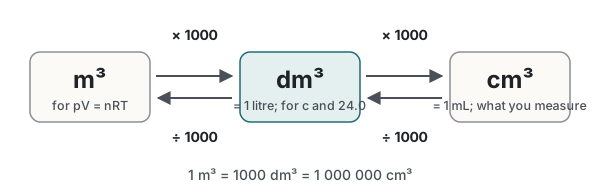
Worked exampleConcentration of a sodium hydroxide solution
2.00 g of NaOH is dissolved in water and made up to 250 cm³ of solution. Find its concentration.
- n = 2.00 ÷ 40.0 = 0.0500 mol
- V = 250 ÷ 1000 = 0.250 dm³
- c = 0.0500 ÷ 0.250 = 0.200 mol dm⁻³
Concentration in g dm⁻³ 1.5
Sometimes concentration is given as the mass of solute per dm³. Moving between the two units is one multiplication by the molar mass:
For the sodium hydroxide solution above: 0.200 × 40.0 = 8.00 g dm⁻³. You can check this directly: 2.00 g ÷ 0.250 dm³ = 8.00 g dm⁻³.
Worked exampleMaking up a hydrated salt solution
What mass of copper(II) sulfate crystals, CuSO₄·5H₂O, is needed to make 250 cm³ of 0.100 mol dm⁻³ solution?
- n = c × V = 0.100 × 0.250 = 0.0250 mol
- M(CuSO₄·5H₂O) = 249.6 g mol⁻¹
- m = 0.0250 × 249.6 = 6.24 g
Parts per million 1.4(iv)
For very small amounts, percentages become awkward strings of zeros. Parts per million (ppm) counts how many parts of a substance there are in every million parts of the whole mixture.
The "amount" must be measured in the same way on the top and the bottom:
- In solutions and solids, ppm is by mass. 1 ppm = 1 g in 10⁶ g = 1 mg in 1 kg.
- In gases, ppm is by volume. 1 ppm = 1 cm³ of the gas in 10⁶ cm³ (1 m³) of air.
Gases in the atmosphere
| Gas | Approximate level in dry air | As a percentage |
|---|---|---|
| nitrogen | 780 000 ppm | 78% |
| oxygen | 210 000 ppm | 21% |
| carbon dioxide | about 420 ppm, and rising | 0.042% |
| methane | about 1.9 ppm | 0.00019% |
Converting is a shift of four powers of ten, because 1% = 10 000 ppm:
Worked exampleCarbon dioxide in a room
How much CO₂ is there in 1.00 dm³ of air containing 420 ppm CO₂?
- 1.00 dm³ = 1000 cm³
- Volume of CO₂ = 1000 × 420 ÷ 10⁶ = 0.420 cm³
Check yourself
- How many moles of HCl are in 25.0 cm³ of 0.100 mol dm⁻³ hydrochloric acid?
- What volume of 0.200 mol dm⁻³ sodium hydroxide solution contains 0.0100 mol of NaOH? Give your answer in cm³.
- A solution of sodium chloride is 0.500 mol dm⁻³. What is its concentration in g dm⁻³?
- A solution contains 9.80 g dm⁻³ of sulfuric acid, H₂SO₄. What is its concentration in mol dm⁻³?
- A 500 g sample of water contains 0.0035 g of lead. What is the lead content in ppm?
- The safe limit for carbon monoxide in a room is 50 ppm. What volume of CO, in cm³, is that in 2.0 m³ of air? Express 50 ppm as a percentage.
Answers cover these until you have tried the questions
- n = 0.100 × (25.0 ÷ 1000) = 2.50 × 10⁻³ mol
- V = n ÷ c = 0.0100 ÷ 0.200 = 0.0500 dm³ = 50.0 cm³
- 0.500 × 58.5 = 29.3 g dm⁻³
- M(H₂SO₄) = 98.1 g mol⁻¹. 9.80 ÷ 98.1 = 0.0999 mol dm⁻³ (about 0.100)
- 0.0035 ÷ 500 × 10⁶ = 7.0 ppm (2 significant figures, as in the data)
- 2.0 m³ = 2.0 × 10⁶ cm³. Volume of CO = 2.0 × 10⁶ × 50 ÷ 10⁶ = 100 cm³ (1.0 × 10² cm³). As a percentage: 50 ÷ 10⁴ = 0.0050%.