Topic 1 · page 1 of 10
Particles and formulae
A formula is a count of atoms. Before you can calculate anything, you need to know what kind of particle a substance is made of and what its formula is counting.
Five words for particles and substances 1.1
Chemists use these words precisely, and examiners mark them precisely.
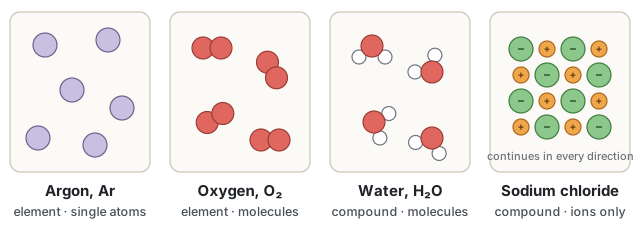
Two of these words describe what a substance is (element or compound). The other three describe what it is made of (atoms, molecules or ions). Every substance needs one word from each group.
| Substance | Element or compound? | Made of |
|---|---|---|
| argon, Ar | element | single atoms |
| oxygen, O₂ | element | molecules |
| water, H₂O | compound | molecules |
| carbon dioxide, CO₂ | compound | molecules |
| sodium chloride, NaCl | compound | ions in a giant lattice |
| diamond, C | element | atoms in a giant covalent lattice |
| silicon dioxide, SiO₂ | compound | atoms in a giant covalent lattice |
Empirical and molecular formulae 1.1
To get the empirical formula from a molecular formula, divide every subscript by the largest number that goes into all of them.
| Substance | Molecular formula | Empirical formula |
|---|---|---|
| ethene | C₂H₄ | CH₂ |
| glucose | C₆H₁₂O₆ | CH₂O |
| hydrogen peroxide | H₂O₂ | HO |
| butane | C₄H₁₀ | C₂H₅ |
| benzene | C₆H₆ | CH |
| water | H₂O | H₂O |
| sodium chloride | none | NaCl |
The molecular formula is always a whole-number multiple of the empirical formula:
You will use this on masses from equations to turn analysis data into a molecular formula.
Check yourself
- Classify each as element or compound, and say whether it is made of atoms, molecules or ions: (a) N₂ (b) MgO (c) neon (d) ammonia, NH₃.
- Give the empirical formula of: (a) C₂H₆ (b) N₂O₄ (c) C₃H₆O (d) P₄O₁₀.
- Explain why magnesium oxide has an empirical formula but no molecular formula.
- A compound has empirical formula CH₂ and relative molecular mass 70. Find its molecular formula.
- State what is wrong with: "An ion is an atom that has gained electrons."
Answers cover these until you have tried the questions
- (a) element, molecules. (b) compound, ions (Mg²⁺ and O²⁻ in a giant lattice). (c) element, single atoms. (d) compound, molecules.
- (a) CH₃ (b) NO₂ (c) C₃H₆O: the numbers 3, 6 and 1 share no common factor, so it does not simplify. (d) P₂O₅
- Magnesium oxide is a giant ionic lattice. There are no separate molecules to count, only a fixed 1 : 1 ratio of Mg²⁺ to O²⁻ ions.
- One CH₂ unit has mass 12.0 + 2(1.0) = 14.0. n = 70 ÷ 14.0 = 5, so the molecular formula is C₅H₁₀.
- It is incomplete. An ion can also form when an atom loses electrons, and an ion can be a group of atoms (for example SO₄²⁻ or NH₄⁺).