Edexcel International A Level Chemistry
Topic 1: Formulae, Equations and Amount of Substance
The toolkit for the whole course. Every calculation you will ever do in chemistry runs through one quantity, the amount of substance in moles.
The one idea
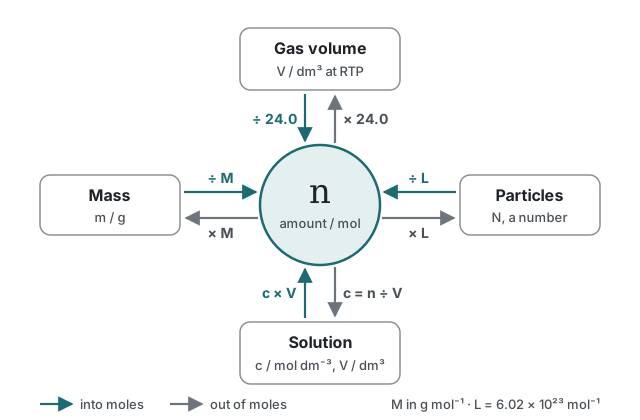
You cannot count atoms, but you can weigh them. The mole is the exchange rate between the mass on a balance and the number of particles in a reaction. Once you have an amount in moles, the balanced equation tells you the amount of everything else.
Almost every question in this topic is the same three moves:
- Into moles from whatever you were given (a mass, a solution, a gas volume).
- Across the equation using the mole ratio.
- Out of moles into whatever you were asked for.
How to use these notes
- Read the pages in order the first time. Later pages assume the earlier ones.
- Each page opens with its one idea in a sentence. If you can explain that sentence to someone else, you know the page.
- Coloured boxes mean the same thing on every page: definitions you may be asked to quote, key ideas, common mistakes, exam technique, and beyond the spec (interesting, but you will not be examined on it).
- Each page ends with questions and fully worked answers. Cover the answers, try the questions, then mark yourself.
- Use the topic on a page the night before an exam.
Relative atomic masses used in these notes are the values printed on the Edexcel IAL periodic table, to one decimal place: H 1.0, C 12.0, N 14.0, O 16.0, Na 23.0, Mg 24.3, Al 27.0, S 32.1, Cl 35.5, K 39.1, Ca 40.1, Fe 55.8, Cu 63.5, Zn 65.4, Br 79.9, Ag 107.9, Ba 137.3.
Pages
- Particles and formulae
A formula is a count of atoms. Before you can calculate anything, you need to know what kind of particle a substance is made of and what its formula is counting.
- Relative mass and the mole
Relative masses compare atoms with carbon-12. The mole turns those relative masses into grams, so that weighing becomes a way of counting.
- Writing equations
A balanced equation is a recipe in moles. It must balance in atoms and, for ionic equations, in charge, and it must say what state each substance is in.
- Masses from equations
Masses are not in the ratio of the coefficients; moles are. Go into moles, use the equation, come back out, and the same idea turns analysis data into a formula.
- Solutions and parts per million
Concentration is just amount per volume. Convert the volume to dm³ first, and a solution becomes another door into the mole.
- Gas volumes
At the same temperature and pressure, a mole of any gas takes up the same volume. Use 24.0 dm³ at room conditions, and pV = nRT in SI units for anything else.
- Core Practical 1: molar volume of a gas
React known masses of calcium carbonate with excess acid, collect the carbon dioxide, and the gradient of volume against moles is the molar volume.
- Yield and atom economy
Percentage yield measures how well an experiment went. Atom economy measures how much of the reactants could ever end up in the product, and it comes from the equation alone.
- Formulae and equations by experiment
To test a formula or an equation, predict what each candidate would give, measure what actually happens, and compare in moles. Then judge how far to trust the measurement.
- Test-tube reactions
Every observation is evidence for a species in the ionic equation. A colour fades because an ion is used up, a precipitate appears because an insoluble solid forms, and fizzing means a gas.
Also in this topic: Topic 1 on a page
Spec checklist
Every point you can be examined on in this topic, and where it is explained. Tick them off as you go.
| Spec | You should be able to | Where |
|---|---|---|
| 1.1 | know the terms atom, element, ion, molecule, compound, empirical formula and molecular formula | Five words for particles and substances Empirical and molecular formulae |
| 1.2 | know that the mole (mol) is the unit for the amount of a substance and be able to perform calculations using the Avogadro constant L (6.02 × 10²³ mol⁻¹) | The mole and the Avogadro constant Molar mass |
| 1.3 | write balanced full and ionic equations, including state symbols, for chemical reactions | Balanced full equations State symbols Ionic equations |
| 1.4(i) | understand the term relative atomic mass, based on the ¹²C scale | Why chemists use a relative scale |
| 1.4(ii) | understand the terms relative molecular mass and relative formula mass, including calculating these values from relative atomic masses (relative formula mass is used for compounds with giant structures) | Relative molecular mass and relative formula mass |
| 1.4(iii) | understand the term molar mass as the mass per mole of a substance in g mol⁻¹ | Molar mass |
| 1.4(iv) | understand parts per million (ppm), including gases in the atmosphere | Parts per million |
| 1.5 | calculate the concentration of a solution in mol dm⁻³ and g dm⁻³ (titration calculations are not required at this stage) | Concentration in mol dm⁻³ Concentration in g dm⁻³ |
| 1.6 | use experimental data to calculate empirical and molecular formulae | Formulae from experimental data Finding a formula: water of crystallisation |
| 1.7 | use chemical equations to calculate reacting masses and vice versa, using amount of substance and molar mass | Reacting masses Limiting reactant |
| 1.8(i) | use chemical equations to calculate volumes of gases and vice versa, using the concept of amount of substance | Equal volumes, equal numbers |
| 1.8(ii) | use chemical equations to calculate volumes of gases and vice versa, using the molar volume of gases | Molar volume |
| 1.8(iii) | use chemical equations to calculate volumes of gases and vice versa, using pV = nRT for gases and volatile liquids | The ideal gas equation |
| 1.9 | calculate percentage yields and percentage atom economies (by mass) in laboratory and industrial processes, using chemical equations and experimental results; atom economy = (molar mass of the desired product ÷ sum of the molar masses of all products) × 100% | Percentage yield Atom economy Yield and atom economy are different |
| 1.10 | determine a formula or confirm an equation by experiment, including evaluation of the data | Evaluating the result Finding a formula: water of crystallisation Confirming an equation Evaluating the data |
| 1.11 | Core Practical 1: measurement of the molar volume of a gas | Aim and reaction Method Results and processing Evaluating the result |
| 1.12(i) | relate ionic and full equations, with state symbols, to observations from simple test-tube experiments: displacement reactions | Describing what you see Displacement reactions |
| 1.12(ii) | relate ionic and full equations, with state symbols, to observations from simple test-tube experiments: typical reactions of acids | Describing what you see Typical reactions of acids |
| 1.12(iii) | relate ionic and full equations, with state symbols, to observations from simple test-tube experiments: precipitation reactions | Describing what you see Precipitation reactions |