Topic 16 · page 7 of 19
Core Practical 12: electrochemical cells
Build cells from pairs of half-cells, measure their voltages with a high-resistance voltmeter, and compare them with the values calculated from standard electrode potentials.
Read first: Cell emf and cell diagrams
Aim and apparatus 16.6
Aim: to investigate some electrochemical cells, by measuring the voltage of cells made from pairs of half-cells and comparing the readings with the values calculated from .
Each half-cell is a metal dipping into a 1.00 mol dm⁻³ solution of its own ions. A filter-paper salt bridge joins the two solutions and a voltmeter joins the two metals.
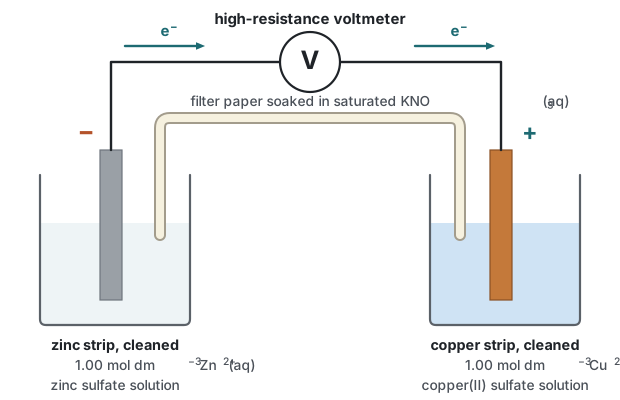
Method 16.6
PracticalMeasuring the emf of a cell
- Clean each metal strip with emery paper to remove the oxide layer.
- Stand each metal in a beaker of a 1.00 mol dm⁻³ solution of its ions. For Fe³⁺/Fe²⁺, use a platinum electrode in a solution containing both ions.
- Join the two solutions with a salt bridge: a strip of filter paper soaked in saturated potassium nitrate solution.
- Connect the metals to a high-resistance voltmeter. Record the reading and which electrode is positive.
- Repeat with other pairs of half-cells, for example Zn/Cu, Cu/Ag and Fe/Cu.
If the voltmeter reads negative, the leads are connected the wrong way round. The metal on the positive lead is really the negative electrode. Swap the leads and record the positive value.
Two questions the examiners ask 16.6
Safety. Silver nitrate solution stains skin. Copper(II) sulfate is harmful. Wear eye protection and gloves.
Results and comparison 16.6
Calculate the expected emf for each pair from the standard electrode potentials, then compare it with your reading.
| Pair of half-cells | Positive electrode | Calculated |
|---|---|---|
| Zn²⁺/Zn and Cu²⁺/Cu | Cu | +0.34 − (−0.76) = +1.10 V |
| Cu²⁺/Cu and Ag⁺/Ag | Ag | +0.80 − (+0.34) = +0.46 V |
| Fe²⁺/Fe and Cu²⁺/Cu | Cu | +0.34 − (−0.44) = +0.78 V |
| Zn²⁺/Zn and Ag⁺/Ag | Ag | +0.80 − (−0.76) = +1.56 V |
| Fe³⁺/Fe²⁺ and Ag⁺/Ag | Ag | +0.80 − (+0.77) = +0.03 V |
Your readings will be close to, but not exactly, these values. Four reasons are worth stating:
- The conditions are not exactly standard: the room is not at exactly 298 K, and the concentrations are not exactly 1.00 mol dm⁻³.
- The metal surfaces may still be slightly oxidised.
- A small current may flow, so the voltmeter does not read the maximum emf.
- Resistance in the salt bridge and in the connections lowers the reading.
Worked examplePredicting a reading
Predict the voltmeter reading for the Fe²⁺/Fe and Zn²⁺/Zn cell, and say which metal is the positive electrode.
- (Zn²⁺/Zn) = −0.76 V and (Fe²⁺/Fe) = −0.44 V.
- Iron is less negative, so iron is the positive electrode.
- = −0.44 − (−0.76) = +0.32 V.
Check yourself
- Why is each metal strip cleaned with emery paper?
- Explain why potassium nitrate, not potassium chloride, is used in the salt bridge for a cell containing silver ions.
- Why must the voltmeter have a high resistance?
- Predict the emf of a Zn/Cu cell and name the positive electrode. Give two reasons your measured value may differ slightly.
- A student connects the leads of the voltmeter to a Cu/Ag cell and reads −0.46 V. Explain what has happened.
- Which of these pairs would give the largest emf: Zn/Cu, Cu/Ag or Zn/Ag? Explain.
Answers cover these until you have tried the questions
- To remove the oxide layer on the surface, which would stop the metal making good contact with its ions and change the reading.
- Potassium nitrate's ions do not react with the half-cell ions. Chloride ions would react with Ag⁺ to form a precipitate of silver chloride, which lowers [Ag⁺] and changes the emf.
- So that almost no current flows. The concentrations do not change, and the reading is the maximum emf.
- = +0.34 − (−0.76) = +1.10 V, with copper positive. The reading may differ because the conditions are not exactly standard (temperature, concentration), and because a small current may flow or the strips may be slightly oxidised.
- The leads are connected the wrong way round: the lead on the positive terminal is attached to the copper. Silver is the positive electrode, so the emf is +0.46 V once the leads are swapped.
- Zn/Ag (+1.56 V, against +1.10 V and +0.46 V). The cell with the largest emf uses the two metals furthest apart in the electrochemical series.