Topic 16 · page 5 of 19
The electrochemical series
Standard electrode potentials are standard reduction potentials. Listed in order, they rank oxidising and reducing agents and are the data you use for every calculation that follows.
Read first: The standard hydrogen electrode and half-cells
Standard reduction potentials 16.13
Every half-equation in a table of standard electrode potentials is written as a reduction, with the electrons on the left:
For this reason standard electrode potentials are also called standard reduction potentials. Put them in order of and you have the electrochemical series.
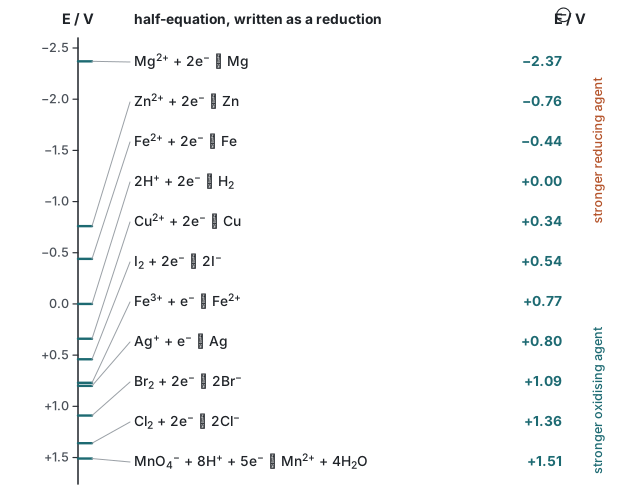
In these notes the most negative value is at the top and the most positive at the bottom. Some books turn the table upside down, so always read the values, not the position.
Reading the series 16.13
The value of tells you how readily the oxidised form (on the left) gains electrons.
- More positive : the oxidised form gains electrons more readily. It is a stronger oxidising agent. Examples: Cl₂ and MnO₄⁻, near the bottom.
- More negative : the oxidised form gains electrons less readily, so the reduced form loses electrons more readily. It is a stronger reducing agent. Examples: Mg and Zn, near the top.
The strongest oxidising agent on the ladder is MnO₄⁻ in acid. The strongest reducing agent is magnesium metal, the reduced form of the top couple. It is the atom, not the ion.
Worked exampleRanking by oxidising power
Put Cl₂, Br₂ and I₂ in order of oxidising power, strongest first.
- Read off the values: Cl₂/Cl⁻ +1.36 V, Br₂/Br⁻ +1.09 V, I₂/I⁻ +0.54 V.
- The most positive value belongs to the strongest oxidising agent.
- Order: Cl₂ > Br₂ > I₂. This is the trend you know from Group 7: oxidising power falls down the group.
Worked exampleRanking by reducing power
Put Zn, Fe and Cu in order of reducing power, strongest first.
- Read off the values: Zn²⁺/Zn −0.76 V, Fe²⁺/Fe −0.44 V, Cu²⁺/Cu +0.34 V.
- The most negative value belongs to the strongest reducing agent (the metal).
- Order: Zn > Fe > Cu.
Using the series 16.13
The series is a table of data, not a list to memorise. In the exam the values are given or you read them from the data booklet. What you must know is how to use them:
- to find a cell voltage by subtracting two values (page 6)
- to predict whether a reaction is feasible (page 9)
- to test whether a species will disproportionate (page 12)
Only the order matters when you rank agents. Your data booklet contains many more couples than the eleven drawn here.
Check yourself
- Why are standard electrode potentials also called standard reduction potentials?
- Which is the stronger oxidising agent, Ag⁺ or Cu²⁺? Use the data on the ladder.
- Which is the strongest reducing agent on the ladder, and why?
- Use the ladder to put Br₂, I₂ and Fe³⁺ in order of oxidising power, strongest first.
- The half-equation for Ag⁺/Ag is Ag⁺ + e⁻ ⇌ Ag, = +0.80 V. A student writes 2Ag⁺ + 2e⁻ ⇌ 2Ag and says is +1.60 V. Another student writes the half-equation as Ag ⇌ Ag⁺ + e⁻ and says it is −0.80 V. Are they right?
Answers cover these until you have tried the questions
- Every half-equation in the table is written as a reduction (electrons on the left).
- Ag⁺. Its (+0.80 V) is more positive than that of Cu²⁺ (+0.34 V), so it gains electrons more readily.
- Magnesium metal. The Mg²⁺/Mg couple has the most negative value (−2.37 V), so Mg loses electrons most readily.
- Br₂ (+1.09 V) > Fe³⁺ (+0.77 V) > I₂ (+0.54 V). Br₂ > Fe³⁺ > I₂.
- Neither is right. is +0.80 V in both cases. It does not depend on how many moles are written, and it does not change sign when the half-equation is reversed: the value belongs to the couple written as a reduction.