Topic 16 · page 4 of 19
The standard hydrogen electrode and half-cells
Single electrodes cannot be measured, so every half-cell is compared with the standard hydrogen electrode, defined as 0.00 V. The half-cell you build depends on whether the couple contains a solid metal.
Read first: From a reaction to a cell
Why a reference electrode is needed 16.4
A voltmeter has two leads and measures a potential difference between them. It cannot measure the potential of one electrode on its own. Dip a second wire into the solution and that wire becomes another electrode, with a potential of its own.
So chemists agree on one reference half-cell and give it the value 0.00 V. Every other half-cell is measured against it, and all the values can then be compared. It is like measuring every mountain from sea level.
The standard hydrogen electrode 16.4
The reference is the standard hydrogen electrode (SHE). It is built from the half-equation
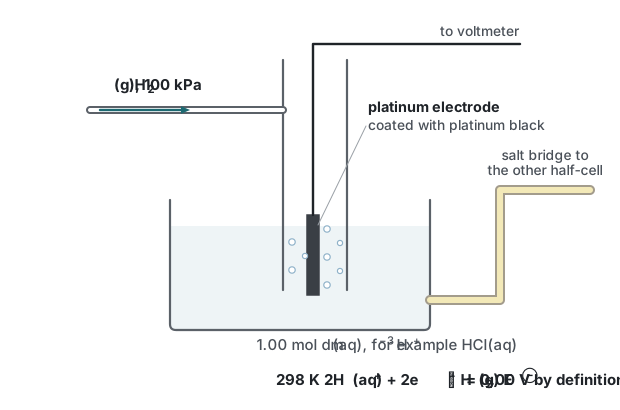
Learn these features as a list. Each is a mark.
- Hydrogen gas at 100 kPa is bubbled over the electrode.
- The electrode is platinum coated with platinum black (finely divided platinum).
- The solution has [H⁺] = 1.00 mol dm⁻³, for example 1.00 mol dm⁻³ hydrochloric acid.
- The temperature is 298 K.
- Its potential is defined as 0.00 V.
Platinum is used because it is inert and conducts electrons, so it takes no part in the reaction. A copper wire would react and set up its own equilibrium. The black coating gives a very large surface area, so the equilibrium between H⁺ and H₂ is reached quickly.
Half-cells for metals and non-metals 16.5(i)
The spec says that different methods are used for different kinds of couple. The rule is simple: if the couple has a solid metal, use it as the electrode. If not, use platinum.
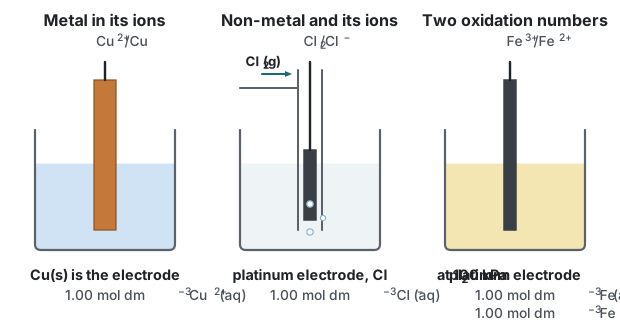
A metal in its ions is the easy case. The metal is the electrode, dipped in 1.00 mol dm⁻³ of its ions. For Cu²⁺/Cu, a copper strip stands in 1.00 mol dm⁻³ Cu²⁺(aq).
A non-metal in its ions cannot be made into an electrode. For Cl₂/Cl⁻, chlorine gas at 100 kPa is bubbled over a platinum electrode in 1.00 mol dm⁻³ Cl⁻(aq). It is the same idea as the hydrogen electrode.
Half-cells for ions of one element 16.5(ii)
Some couples contain two ions of the same element with different oxidation numbers, such as Fe³⁺/Fe²⁺. There is no solid metal to use as the electrode.
Use a platinum electrode dipping into a solution containing both ions, each at 1.00 mol dm⁻³. The platinum is inert. It only carries electrons into and out of the solution.
Worked exampleA half-cell for bromine and bromide
Describe a half-cell to measure (Br₂/Br⁻).
- There is no solid metal in the couple, so use a platinum electrode.
- It dips into a solution containing Br⁻(aq) at 1.00 mol dm⁻³ and Br₂ (aqueous bromine).
- Connect it to a standard hydrogen electrode with a salt bridge. The voltmeter reading is .
Iodine and iodide work in the same way.
Check yourself
- Why can the potential of a single electrode not be measured?
- List the features of the standard hydrogen electrode.
- Why is the platinum in a hydrogen electrode coated with platinum black?
- Describe the half-cell used to measure for Cl₂/Cl⁻.
- Describe the half-cell used to measure for Fe³⁺/Fe²⁺.
- Why is a copper wire not used as the electrode in a hydrogen half-cell?
Answers cover these until you have tried the questions
- A voltmeter measures only a potential difference between two points. Any second connection to the solution is itself an electrode, so one electrode cannot be measured alone.
- Hydrogen gas at 100 kPa; a platinum electrode coated with platinum black; 1.00 mol dm⁻³ H⁺(aq); 298 K; potential defined as 0.00 V.
- Platinum black has a very large surface area, so the equilibrium between H⁺ and H₂ is set up quickly. (Platinum is also inert and conducts.)
- Chlorine gas at 100 kPa is bubbled over a platinum electrode in 1.00 mol dm⁻³ Cl⁻(aq) at 298 K, connected to a standard hydrogen electrode by a salt bridge.
- A platinum electrode in a solution containing both Fe³⁺(aq) and Fe²⁺(aq), each at 1.00 mol dm⁻³, at 298 K, connected to a standard hydrogen electrode by a salt bridge.
- Copper is not inert. It would react and set up its own equilibrium with Cu²⁺, so the potential measured would not be that of hydrogen.